Introduction
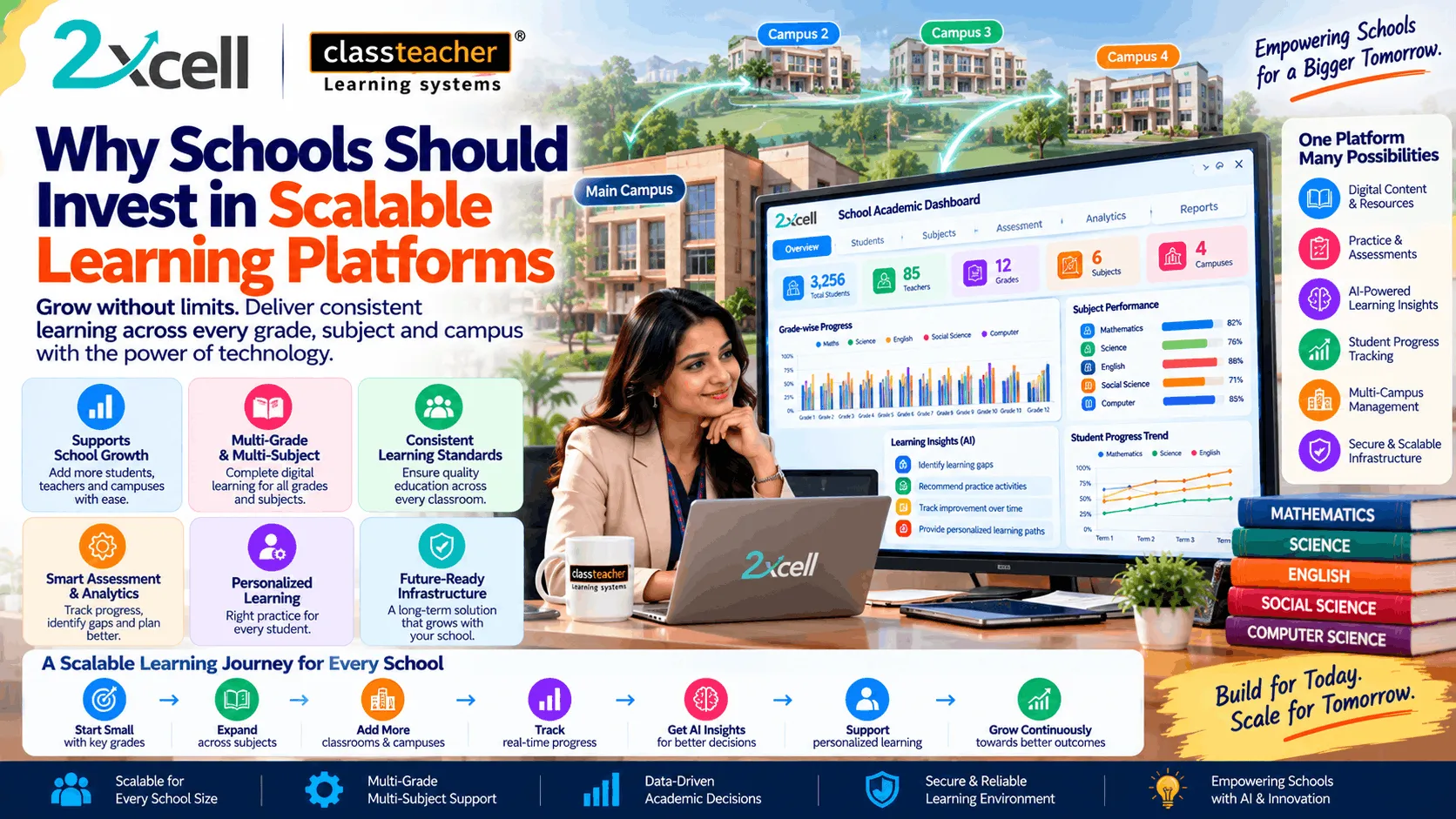
As schools grow, their academic and technology requirements grow with them. A school that begins with a limited number of classrooms may eventually expand to multiple grades, additional sections, new subjects, and even several campuses.
With this growth comes a practical challenge: how can schools expand their learning infrastructure without making academic management increasingly complicated?
A platform that works well for a small group of students may become difficult to manage when the number of teachers, learners, learning resources, and assessments increases.
Schools need digital learning systems that can accommodate growth while maintaining usability, academic consistency, and flexibility.
This is where scalable learning platforms become important.
Rather than replacing technology whenever requirements change, schools can invest in platforms designed to support evolving educational needs.
A scalable learning environment can follow this approach:
Start Small → Connect Learning → Expand Access → Monitor Progress → Improve Continuously
The objective is not simply to introduce more technology. It is to build a digital foundation that can support the school's long-term academic development.
What Is a Scalable Learning Platform?
A scalable learning platform is a digital education system designed to accommodate increasing users, content, activities, and academic requirements as an institution grows.
Depending on its capabilities, such a platform may support:
- Multiple grades and sections
- Different academic subjects
- Growing numbers of students and teachers
- Digital learning content
- Online assessments and practice
- Student progress tracking
- Learning analytics
- Personalized learning activities
- Multiple school branches
- Integration with other educational systems
Scalability also involves more than adding users. A useful platform should remain manageable, responsive, and appropriate for the institution's changing needs.
For example, a school expanding from 20 classrooms to 60 classrooms may need additional digital resources, assessment capacity, teacher access, and reporting capabilities.
A scalable platform can help the school plan for these requirements without creating disconnected systems for every new need.
Why Scalability Matters in Modern Education
Educational institutions rarely remain static. Student enrolment changes, curricula evolve, new subjects are introduced, and teaching practices develop.
A scalable platform can help schools adapt to these changes through a more flexible digital infrastructure.
Without a clear scalability strategy, schools may end up using separate applications for content, assessments, reporting, and student monitoring. This can increase administrative complexity and make academic information harder to coordinate.
A well-planned platform can help connect these activities within a more consistent learning environment.
1. Supports School Growth Without Constant System Replacement
One major advantage of investing in scalable technology is the ability to plan for future expansion.
Consider a school that initially introduces digital learning in a few classrooms. Over time, it decides to extend the system across all grades.
If the original platform cannot accommodate the additional users or requirements, the school may need to migrate its content, retrain teachers, and introduce a new system.
A scalable platform can reduce the likelihood of such disruption when its capacity and features are suitable for the planned expansion.
Schools should evaluate whether a platform can support:
- Additional students
- More teachers and administrators
- New grades and subjects
- Increased digital content
- Larger assessment volumes
- Additional campuses
The key is to select technology according to both current requirements and realistic future needs.
2. Makes Digital Learning Available Across More Classrooms
Digital learning should not remain limited to a few demonstration classrooms.
As schools expand their use of technology, teachers across different grades and subjects may need access to digital lessons, practice activities, assessments, and educational resources.
A scalable platform can help extend these resources to more classrooms through a common digital environment.
For example, a school can gradually introduce digital learning in mathematics, science, English, and computer science rather than managing an entirely separate system for each subject.
This can make technology adoption more structured and easier to manage.
3. Helps Maintain Academic Consistency Across Grades
As the number of grades increases, maintaining alignment with academic expectations becomes more important.
Schools need to ensure that teachers can access appropriate learning resources and work towards clearly defined learning objectives.
A scalable learning platform can help organize content according to:
- Grade level
- Subject
- Topic
- Learning objective
- Difficulty level
- Assessment requirement
This structure can make it easier for academic teams to manage resources across grades.
However, consistency does not mean that every classroom must follow an identical teaching method. Teachers should retain the flexibility to adapt resources to their students.
4. Supports Multiple Subjects Within One Learning Environment
Schools often need different types of digital resources for different subjects.
Science may require diagrams and simulations, mathematics may benefit from interactive practice, and language learning may involve reading, listening, and writing activities.
When these resources are spread across unrelated systems, teachers may need to switch between several tools.
A platform that supports multiple subjects can help bring relevant learning activities into a more connected environment.
Schools should assess whether the platform offers appropriate subject coverage and whether additional tools can be integrated when necessary.
The goal is to simplify access without forcing every subject into the same learning format.
5. Helps Schools Manage Growing Student Data
As student numbers increase, the amount of academic information generated by assessments, practice activities, and classroom learning also grows.
Managing this information manually can become time-consuming.
Depending on its capabilities, a scalable platform can help schools organize:
- Assessment results
- Student progress records
- Topic-wise performance
- Practice completion
- Learning gaps
- Academic improvement over time
Structured information can help teachers and school leaders review student progress more efficiently.
Schools should also ensure that the platform has appropriate data protection, access controls, and reporting features.
6. Enables More Informed Academic Decisions
Academic decisions become more difficult when information is incomplete or scattered across multiple records.
A connected learning environment can help school leaders review relevant performance indicators and identify areas that require further investigation.
For example, if students across several sections struggle with the same mathematics topic, academic coordinators can review assessment results and discuss whether additional resources or teaching support may be useful.
Learning analytics can help highlight patterns, but the data should be interpreted in context.
Learning Data → Academic Review → Targeted Action → Progress Evaluation
This process helps schools connect digital information with practical academic decisions.
7. Supports Personalized Learning at Greater Scale
Personalized learning can become difficult to manage when every student requires different resources and practice activities.
AI-enabled learning platforms may help recommend suitable content or practice based on relevant learning information.
For example:
Student A: Needs additional foundational practice.
Student B: Is ready for application-based questions.
Student C: May benefit from advanced challenges.
A scalable platform can help organize these different learning pathways while keeping them connected to the school's academic objectives.
The availability of personalization depends on the platform's actual features, data quality, and implementation.
Teachers should remain involved in reviewing recommendations and deciding what support students need.
8. Reduces Dependence on Disconnected Tools
As schools adopt more technology, they may gradually accumulate separate tools for teaching, assessments, communication, reporting, and content management.
Although individual tools may be useful, managing too many disconnected systems can create unnecessary complexity.
Teachers may need to maintain duplicate records, remember multiple logins, or transfer information manually.
A scalable platform can help consolidate relevant learning activities where appropriate.
Before investing, schools should examine whether the system integrates with existing tools and whether consolidation would genuinely simplify their workflows.
The objective is not to eliminate every specialized application. It is to avoid unnecessary fragmentation.
9. Helps Teachers Adapt to Changing Academic Requirements
Teaching requirements change over time. Schools may introduce new curricula, additional subjects, updated assessment practices, or technology-supported teaching methods.
A scalable learning platform can help schools expand or update their digital learning resources as these requirements evolve.
Teachers may need access to:
- Updated digital lessons
- New practice activities
- Revised assessments
- Additional revision resources
- Subject-specific content
- Digital teaching tools
A flexible platform can make these additions easier to manage when its content and configuration support them.
Teacher training remains essential to ensure that new capabilities are used effectively.
10. Makes Multi-Branch Academic Management Easier
For school groups operating multiple campuses, scalability involves more than increasing the number of users.
Academic teams may need to coordinate learning resources, assessment practices, and progress monitoring across branches.
A suitable platform can help organize common academic resources while allowing individual campuses to address local requirements.
For example, a school group with campuses in different cities may establish shared learning objectives and assessment frameworks while giving teachers flexibility in classroom delivery.
Schools should verify that a platform supports the required branch-level access, reporting, and administration features before adopting it.
11. Supports More Structured Assessments
Assessment requirements can grow alongside the school.
A larger institution may conduct classroom quizzes, periodic tests, subject assessments, revision exercises, and examinations across several grades.
A scalable platform can help organize these activities according to the school's academic structure.
Depending on its features, it may support:
- Digital quizzes
- Question banks
- Subject-specific assessments
- Automated scoring for supported question types
- Assessment reports
- Student-level performance tracking
- Follow-up practice
This can make assessment management more structured while helping teachers review the results.
Human review remains important for open-ended answers, practical work, and assessments requiring professional judgment.
12. Can Improve Long-Term Technology Planning
Investing in scalable technology requires schools to think beyond the immediate academic year.
A platform should be evaluated according to its expected usefulness over time, the cost of expanding its capacity, and the effort required to maintain it.
Schools can consider:
- Current licensing costs
- Additional-user pricing
- Implementation expenses
- Teacher training
- Integration costs
- Technical support
- Data storage requirements
- Upgrade policies
- Contract flexibility
A lower initial price does not always mean a lower long-term cost.
Similarly, a large platform is not automatically the best investment if the school will use only a small portion of its features.
The right decision depends on the school's actual needs and growth plans.
13. Helps Schools Evaluate the Return on EdTech Investment
Scalable platforms should deliver educational and operational value, not just additional features.
Schools can measure their investment using indicators such as:
Adoption
- Number of active teachers
- Number of classrooms using the platform
- Student participation
Academic Use
- Assessments conducted
- Learning resources accessed
- Practice activities completed
Operational Efficiency
- Time spent preparing reports
- Reduction in duplicate data entry
- Ease of managing academic resources
Learning Outcomes
- Assessment performance
- Progress on learning objectives
- Improvement in identified learning gaps
These measures should be interpreted carefully. Increased platform usage alone does not prove improved academic performance.
A useful evaluation connects platform activity with meaningful educational and operational outcomes.
14. Supports Technology Integration Over Time
Schools may already use smart classroom equipment, learning management systems, assessment tools, or student information systems.
A scalable platform should be evaluated according to how well it fits into this existing environment.
Relevant questions include:
- Can it integrate with existing systems?
- Can student records be imported securely?
- Are supported data formats compatible?
- Can teachers access resources conveniently?
- Are integration costs clearly defined?
- Can the school export its data if required?
Integration can help reduce duplicated work, but compatibility should be verified before a purchase decision.
15. Helps Schools Prepare for AI-Enabled Education
AI is creating new possibilities for educational content, assessment, analytics, and personalized learning.
Schools may want to explore these capabilities gradually rather than replacing their entire digital infrastructure at once.
A scalable learning platform can provide a foundation for adopting suitable AI-supported features as academic needs evolve.
These may include:
- Learning resource recommendations
- Practice personalization
- Performance pattern analysis
- Learning-gap indicators
- Automated summaries
- Academic progress insights
AI capabilities should be evaluated for accuracy, transparency, privacy, and educational usefulness.
Schools should also ensure that AI recommendations support teacher judgment rather than making unsupported conclusions about students.
16. Can Support Learning Beyond the Physical Classroom
Modern learning may involve classroom teaching, homework, digital practice, revision, and independent study.
A scalable platform can help connect these activities when students and teachers need access to learning resources beyond the classroom.
For example, a student may:
- Learn a concept during a classroom lesson.
- Review a related digital explanation.
- Complete practice questions.
- Check performance through an assessment.
- Revisit areas requiring additional work.
This creates a more connected learning journey.
The specific experience depends on the platform's accessibility, supported devices, connectivity requirements, and available features.
17. Makes Content Management More Structured
As a school's digital library grows, teachers need ways to find appropriate resources without searching through large collections manually.
A scalable platform can help organize educational content according to subjects, grades, topics, and learning objectives.
This can support:
- Easier resource discovery
- Reuse of suitable content
- More structured lesson preparation
- Better organization of revision material
- Consistent access to approved resources
Schools should also review content quality, curriculum alignment, licensing, and the process for updating outdated material.
18. Supports Responsible Growth and Data Security
As more teachers, students, and campuses use a platform, data protection becomes increasingly important.
Schools should evaluate whether the provider offers appropriate security and administration controls.
Important considerations include:
- Role-based access
- Secure authentication
- Protection of student records
- Data backup and recovery
- Clear data retention policies
- Appropriate consent practices
- Responsible AI use
- Secure data export and deletion procedures
Schools should understand where data is stored, who can access it, and how it is handled throughout the service relationship.
Scalability should never come at the expense of student privacy or system security.
19. How 2xcell Can Support Scalable Digital Learning
The 2xcell AI Learning Platform by CLASSTEACHER Learning Systems can support a connected digital learning environment involving learning content, practice, assessments, analytics, personalized learning, and student progress tracking.
For schools planning to expand their digital learning activities, this type of connected approach can help bring important learning processes into a more structured environment.
A connected learning cycle can follow:
Learn → Practise → Assess → Analyse → Personalize → Improve
Schools can evaluate how these capabilities align with their current requirements and future plans, including the number of grades, subjects, teachers, students, and campuses they expect to support.
The most suitable implementation will depend on the platform's available features, integration requirements, configuration, and the school's academic priorities.
The objective is to establish a digital learning foundation that can evolve with the institution rather than adding technology without a clear purpose.
20. How Schools Can Choose the Right Scalable Learning Platform
Before investing, schools should follow a structured evaluation process.
Step 1: Identify Current Challenges
Determine whether the main requirement is digital content, assessments, academic reporting, personalization, or system integration.
Step 2: Estimate Future Requirements
Consider expected student enrolment, additional grades, new subjects, and potential branch expansion.
Step 3: Evaluate Core Features
Check whether the platform supports the essential academic and administrative workflows.
Step 4: Review Ease of Use
Ask teachers and academic coordinators to evaluate the platform before making a large-scale commitment.
Step 5: Verify Integration and Security
Confirm compatibility with existing systems and review data protection practices.
Step 6: Calculate Total Cost of Ownership
Include subscriptions, implementation, training, support, integrations, and future expansion costs.
Step 7: Conduct a Pilot
Test the platform with a representative group of teachers and students before expanding it across the school.
Step 8: Measure Results
Review adoption, usability, operational efficiency, and meaningful academic indicators.
This approach can help schools make decisions based on evidence rather than feature lists alone.
Common Mistakes Schools Should Avoid
Investing in scalable learning technology does not guarantee successful implementation.
Schools should avoid several common mistakes:
Choosing Based Only on Price: A low-cost platform may not meet future requirements, while an expensive platform may offer unnecessary features.
Ignoring Teacher Training: Even useful technology can remain underused when teachers do not receive appropriate guidance.
Overlooking Integration: Disconnected systems can create additional work instead of simplifying processes.
Expanding Too Quickly: A pilot can reveal usability, training, and technical issues before school-wide deployment.
Measuring Only Usage: Logins and completed activities should be considered alongside educational and operational outcomes.
Ignoring Data Security: Student information requires appropriate safeguards as platform usage expands.
The most effective approach combines suitable technology, realistic planning, teacher involvement, and regular evaluation.
The Future of Scalable Learning Platforms
As schools continue to adopt digital learning and AI-supported tools, scalable platforms may play an increasingly important role in connecting academic activities.
A future-ready learning environment could bring together:
Digital Content
↓
Classroom Instruction
↓
Practice and Assessment
↓
Learning Analytics
↓
Personalized Support
↓
Progress Monitoring
↓
Academic Improvement
Such an environment can help schools expand their digital capabilities while maintaining a focus on learning quality, teacher support, and student development.
The goal is not to introduce every available technology. It is to build a system that can adapt as the school's requirements change.
Conclusion
Schools need digital learning infrastructure that can grow alongside their academic ambitions. As student enrolment increases and educational requirements evolve, platforms that support additional grades, subjects, assessments, users, and learning activities can help schools manage change more effectively.
Scalable learning platforms can support structured content management, connected assessments, learning analytics, personalized practice, and more informed academic planning.
However, successful investment requires more than choosing software. Schools must consider usability, teacher training, integration, data security, total cost, and measurable outcomes.
With the 2xcell AI Learning Platform by CLASSTEACHER Learning Systems, schools can explore a connected approach to digital learning, assessments, analytics, personalized learning, and student progress tracking.
The long-term objective is clear:
Build for Today. Scale for Tomorrow. Keep Learning at the Centre.