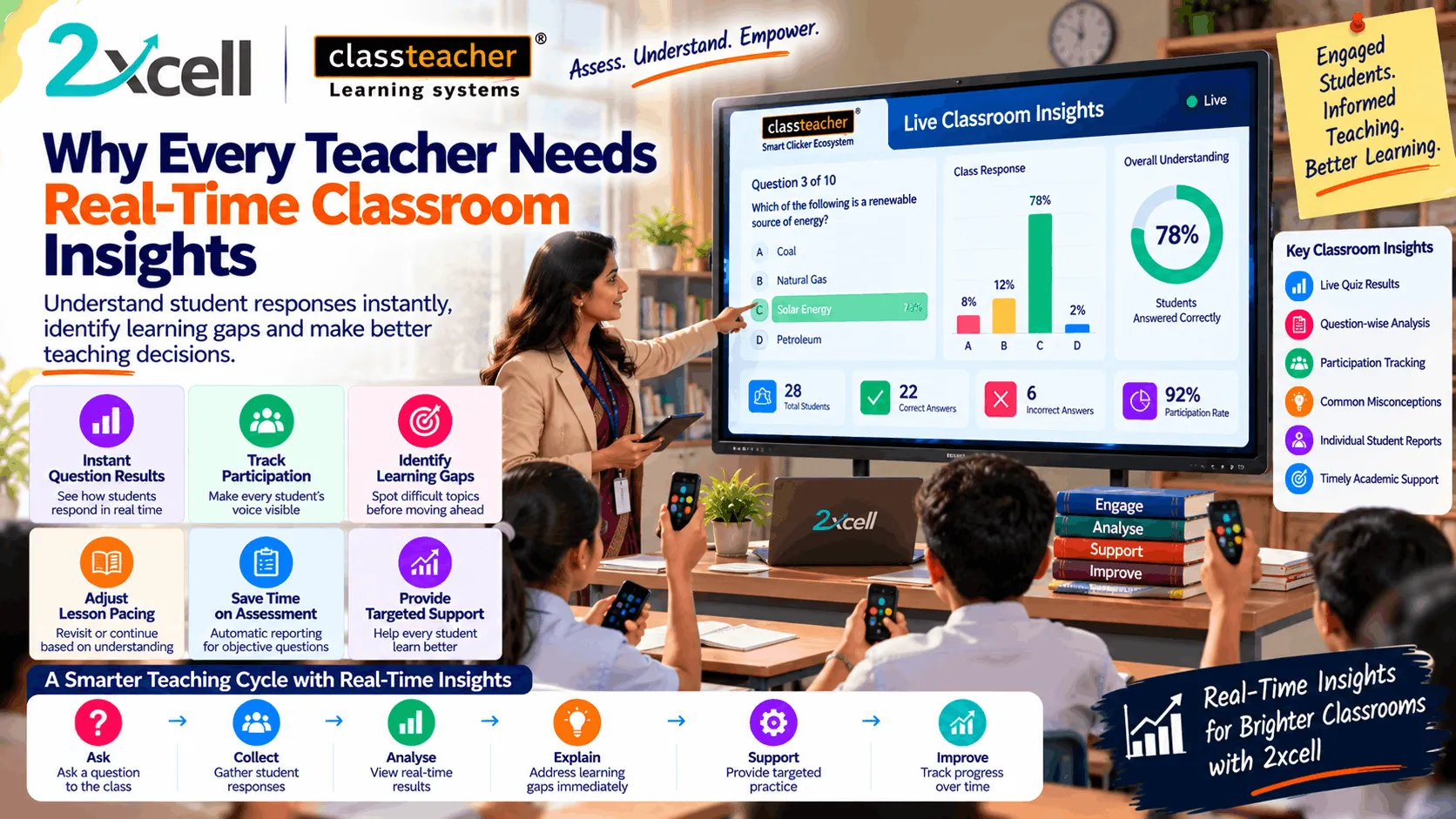
Introduction
A teacher's job involves much more than delivering lessons. Every day, teachers make important decisions about lesson pacing, student participation, concept understanding, classroom activities, and academic support.
However, understanding what is happening across an entire classroom can be challenging. Some students may understand a concept immediately, while others may hesitate to ask questions. A few learners may answer confidently, while others remain silent despite having difficulties.
Traditional assessments and periodic examinations provide useful information, but they may not reveal every learning challenge while a lesson is taking place.
This is where real-time classroom insights can make a meaningful difference.
By using interactive assessments, digital response systems, classroom activities, and learning analytics, teachers can receive timely information about student responses and understanding. This information can help them adjust their teaching approach before moving to the next topic.
The objective is simple:
Teach → Observe → Understand → Respond → Improve
Real-time insights help teachers make classroom decisions based on what students are demonstrating during the learning process, rather than relying only on assumptions or results received later.
What Are Real-Time Classroom Insights?
Real-time classroom insights are timely indicators that help teachers understand student participation, responses, and learning progress during or shortly after a classroom activity.
Depending on the technology being used, these insights may include:
- Student responses to classroom questions
- Live quiz results
- Question-wise accuracy
- Common misconceptions
- Participation levels
- Topic-wise assessment performance
- Areas requiring additional explanation
- Student progress during a lesson
- Immediate assessment results
- Trends across classroom activities
For example, a teacher conducting a science lesson can ask students a multiple-choice question and review their responses immediately.
If a large proportion of students select the wrong answer, the teacher can revisit the concept before continuing.
This turns assessment into an active part of teaching rather than something that happens only after the lesson.
Why Traditional Classroom Observation May Not Be Enough
Teachers observe students throughout the school day, but classroom observation has practical limitations.
In a class with many students, it can be difficult to determine whether everyone has understood a concept simply by asking, "Does everyone understand?"
Some students may not respond. Others may avoid asking questions because they feel uncomfortable. A few confident learners may answer repeatedly, while quieter students remain unnoticed.
Traditional assessment can also involve delays when teachers need to collect notebooks, evaluate responses, calculate scores, and identify recurring mistakes.
Real-time classroom tools can help address some of these challenges by collecting responses from more students and organizing the results for quicker review.
The teacher's professional judgement remains essential, but timely information can make that judgement more informed.
1. Identify Learning Gaps Before Moving to the Next Topic
One of the most important benefits of real-time insights is the ability to identify misunderstandings during a lesson.
Consider a mathematics class where the teacher explains fractions.
After the explanation, the teacher asks students to solve a short question using an interactive response system.
The results show that many students have confused the numerator and denominator.
Instead of moving to the next topic, the teacher can explain the concept again using diagrams and additional examples.
The process becomes:
Teach a Concept → Check Understanding → Identify the Gap → Explain Again
This approach can help prevent small misunderstandings from affecting more advanced topics.
2. Make Classroom Participation More Visible
A classroom can appear attentive even when only a small number of students are actively participating.
Interactive quizzes, polls, and digital response devices provide additional opportunities for students to submit answers.
Teachers can use these activities to understand how many learners are responding and whether participation changes across different lessons.
For example, a teacher can ask every student to select an answer rather than relying on volunteers alone.
This can create more opportunities for quieter students to participate without requiring them to speak in front of the entire class.
Participation data should still be interpreted carefully. A submitted answer does not automatically prove understanding, but it gives teachers another useful signal.
3. Receive Immediate Results Without Waiting for Manual Checking
Manual evaluation can consume valuable teaching time, especially when teachers conduct frequent short assessments.
Digital assessment systems can automatically record responses and display results for supported question types.
Depending on the system, teachers may be able to review:
- Total correct and incorrect responses
- Overall class accuracy
- Question-wise performance
- Individual student responses
- Commonly selected options
- Assessment summaries
This can reduce the time spent checking objective questions and allow teachers to focus more on explaining concepts and supporting learners.
Written answers, projects, and other complex assessments may still require teacher evaluation.
4. Adjust Lesson Pacing According to Student Understanding
Every class progresses differently.
A topic that requires ten minutes in one classroom may need additional explanation in another. Continuing at the planned pace without checking understanding can leave some students behind.
Real-time assessment gives teachers an opportunity to decide whether to proceed, revise, or introduce another activity.
For example:
An Example of Data-Informed Teaching
Step 1: Teach
Explain the concept using the planned lesson.
Step 2: Check
Ask a short question and review student responses.
Step 3: Decide
Continue if understanding is sufficient, or revisit the difficult concept.
This gives teachers more flexibility to respond to actual classroom needs instead of following a fixed pace regardless of student understanding.
5. Understand Which Questions Students Find Difficult
An overall test score may show how a class performed, but it does not always explain why.
Question-wise analysis can help teachers identify specific concepts that need attention.
For example, a science quiz might contain five questions:
Question
Correct responses
Question 1
90%
Question 2
84%
Question 3
48%
Question 4
81%
Question 5
87%
In this illustrative example, Question 3 has a much lower success rate than the others.
The teacher can review the question, check whether its wording was clear, and investigate whether students need another explanation of the underlying concept.
This is more actionable than knowing only that the class achieved an average score.
6. Provide More Targeted Academic Support
Students in the same classroom may have different learning requirements.
Some may need foundational practice, others may benefit from additional examples, and some may be ready for more challenging questions.
Real-time insights can help teachers identify students or groups who may need further attention.
Possible responses include:
- Revisiting a difficult concept with a small group
- Providing additional practice questions
- Offering a different explanation
- Assigning revision activities
- Giving advanced tasks to students ready to progress
- Following up with students who repeatedly struggle
The objective is not to label students according to their scores. It is to make academic support more relevant to their needs.
7. Make Formative Assessment Part of Everyday Teaching
Assessment does not need to be limited to unit tests and final examinations.
Teachers can use short formative assessments throughout the learning process to check whether students are following a lesson.
Examples include:
- A quick multiple-choice quiz
- A one-question concept check
- A live classroom poll
- A matching activity
- A short digital assessment
- An exit question at the end of a lesson
These activities can provide timely feedback to both teachers and students.
The results can also help teachers decide what to revise in the next lesson.
Frequent, low-pressure checks can make assessment a learning tool rather than simply a method of assigning marks.
8. Encourage Students to Learn From Their Mistakes
Mistakes can reveal how students are interpreting a concept.
When a teacher identifies a common incorrect response, it becomes an opportunity to explain the reasoning behind the correct answer.
For example, if students repeatedly select the same incorrect option in a science quiz, the teacher can explain why that option may seem plausible and where the misunderstanding occurs.
The learning cycle becomes:
Answer → Review → Understand the Mistake → Practise → Improve
This can help students develop a clearer understanding instead of memorizing the correct option without understanding the concept.
9. Support More Interactive Classrooms
Real-time classroom tools can make lessons more participatory.
Teachers can incorporate quizzes, polls, prediction questions, and short challenges into their explanations.
For example, during a geography lesson, students can predict the result of a change in rainfall patterns. During mathematics, they can select the correct solution to a problem. In science, they can answer questions before observing an experiment.
These activities encourage students to think about the content as the lesson progresses.
However, interaction should always serve a clear learning objective. Too many quizzes or unnecessary digital activities can interrupt teaching rather than improve it.
10. Reduce Administrative Work Related to Objective Assessments
Teachers balance lesson preparation, classroom instruction, student support, reporting, and other responsibilities.
When a digital response system automatically captures and organizes objective assessment results, some repetitive administrative tasks can become easier.
Depending on the system's capabilities, teachers may be able to:
- Conduct objective tests
- Record student responses automatically
- Review class results quickly
- Examine question-wise performance
- Track individual responses
- Export assessment reports
- Identify topics requiring further review
This can reduce certain manual tasks and help teachers spend more time interpreting results and planning instruction.
Automation does not eliminate the need to review assessment quality or evaluate answers that require human judgement.
11. Track Progress Across Multiple Lessons
A single classroom quiz provides a snapshot of understanding. Repeated assessments can help teachers observe progress across a series of lessons.
For example, students may initially struggle with a topic but show improvement after additional explanations and practice.
Teachers can compare results from relevant activities to understand whether their instructional approach is helping.
A useful cycle is:
Initial Assessment → Teaching → Practice → Follow-Up Assessment → Progress Review
These comparisons should account for differences in question difficulty and assessment conditions.
When used thoughtfully, progress tracking can help teachers identify where students are improving and where additional support remains necessary.
12. Support Better Decisions During Parent-Teacher Discussions
Real-time insights can also contribute to more informed conversations with parents when assessment information is recorded and reviewed over time.
Instead of discussing only a final grade, teachers may be able to explain:
- Which concepts the student understands well
- Which topics require further practice
- How performance has changed
- What support has already been provided
- Which next steps may be helpful
For example, a teacher may explain that a student performs well in basic science questions but needs more practice with application-based questions.
This creates a more specific conversation about learning needs and possible support.
Classroom assessment data is only one part of a student's overall academic picture and should be combined with teacher observations and other relevant information.
13. Help School Leaders Understand Classroom-Level Trends
When schools use consistent assessment practices, aggregated results can help academic coordinators and school leaders identify broader patterns.
For example, several classes may struggle with the same curriculum topic. This could indicate a need to review learning resources, assessment design, lesson pacing, or teacher support.
School leaders may examine:
- Class-level assessment trends
- Frequently misunderstood concepts
- Participation patterns
- Progress across grades or sections
- Areas where additional academic resources may help
The objective should be to improve teaching and learning, not simply rank teachers according to student scores.
Classroom context, student backgrounds, and assessment quality all matter when interpreting these trends.
14. How Smart Audience Response Systems Support Real-Time Insights
A Smart Audience Response System (SRS) allows teachers to ask questions and collect student responses through compatible response devices or digital interfaces.
For example, Classteacher's Smart Clickers ecosystem is designed to support interactive classroom assessments.
Depending on the configured system, teachers can use response tools to conduct objective tests, capture answers, and review results.
A typical classroom workflow can look like:
- The teacher creates or selects a quiz.
- Students answer using compatible response devices.
- Responses are collected by the system.
- The teacher reviews available results and reports.
- Difficult concepts are revisited where necessary.
This approach can help connect classroom questions with timely assessment information.
The value comes not only from collecting responses but from using the information to make better instructional decisions.
15. How Classteacher Can Help Teachers Use Classroom Insights
Classteacher Learning Systems provides classroom technology and assessment solutions designed to support interactive teaching and digital learning.
Its Smart Clickers ecosystem can support objective assessments, student response collection, and timely classroom feedback through the relevant hardware and software.
When teachers can see how students have responded to a question, they have another source of information for deciding what to explain next.
A practical teaching cycle is:
Ask → Collect Responses → Review Results → Explain → Reassess
Combined with effective lesson planning and teacher expertise, these tools can help make classroom assessment more responsive.
The aim is to help teachers understand student responses while the lesson is still taking place, rather than relying exclusively on later examination results.
16. What Schools Should Consider Before Adopting Real-Time Classroom Tools
Schools should choose technology based on their classroom requirements, infrastructure, and teaching objectives.
Ease of Use
Can teachers conduct assessments without complicated setup?
Curriculum Alignment
Can questions and activities support the school's learning objectives?
Timely Reporting
Can teachers access useful results soon after students respond?
Assessment Quality
Are questions accurate, clear, and appropriate for the students' grade level?
Classroom Integration
Can the system fit naturally into existing teaching practices?
Teacher Training
Will teachers receive guidance on interpreting results and using them effectively?
Data Privacy
Are student responses and assessment records handled securely?
Accessibility
Can students participate fairly, including those who may need additional support?
A successful implementation depends on more than the technology itself. Teachers need time, training, and appropriate assessment practices to turn classroom information into meaningful improvements.
17. Real-Time Insights Should Support Teachers, Not Replace Them
Technology can help collect responses, summarize results, and highlight patterns. It cannot fully understand every reason behind a student's answer or classroom behaviour.
A student may answer incorrectly because the concept is unclear, the question is confusing, or the student misunderstood the instructions.
Teachers bring the context needed to interpret these situations.
The best approach combines:
Classroom Data + Teacher Expertise + Student Understanding = Better Instructional Decisions
Real-time insights should strengthen professional judgement, not dictate every teaching decision.
The Future of Real-Time Classroom Insights
As classroom technology develops, teachers may increasingly combine interactive response systems, digital assessments, and learning analytics to make lessons more responsive.
A future classroom workflow could connect:
Lesson Delivery
↓
Interactive Question
↓
Student Responses
↓
Real-Time Results
↓
Teacher Interpretation
↓
Targeted Explanation or Practice
↓
Follow-Up Assessment
This can help schools create a continuous feedback loop between teaching and learning.
The objective is not to measure every student constantly. It is to collect useful information at appropriate moments and act on it constructively.
Conclusion
Every teacher needs a practical way to understand whether students are following a lesson, where misconceptions are emerging, and what should happen next.
Real-time classroom insights can help by making student responses more visible, reducing delays in objective assessment, identifying difficult concepts, and supporting more targeted instruction.
When combined with teacher expertise, formative assessment, and appropriate follow-up, these insights can help classrooms become more interactive and responsive to student needs.
With Classteacher's Smart Clickers ecosystem and classroom technology solutions, schools can explore ways to connect interactive assessment with timely feedback and better-informed teaching decisions.
The goal is not simply to collect more classroom data. It is to use the right information at the right time to help every student understand more effectively.
Ask Better Questions. Understand Student Responses. Teach With Greater Insight.
Classteacher Learning Systems
Assess. Understand. Empower.