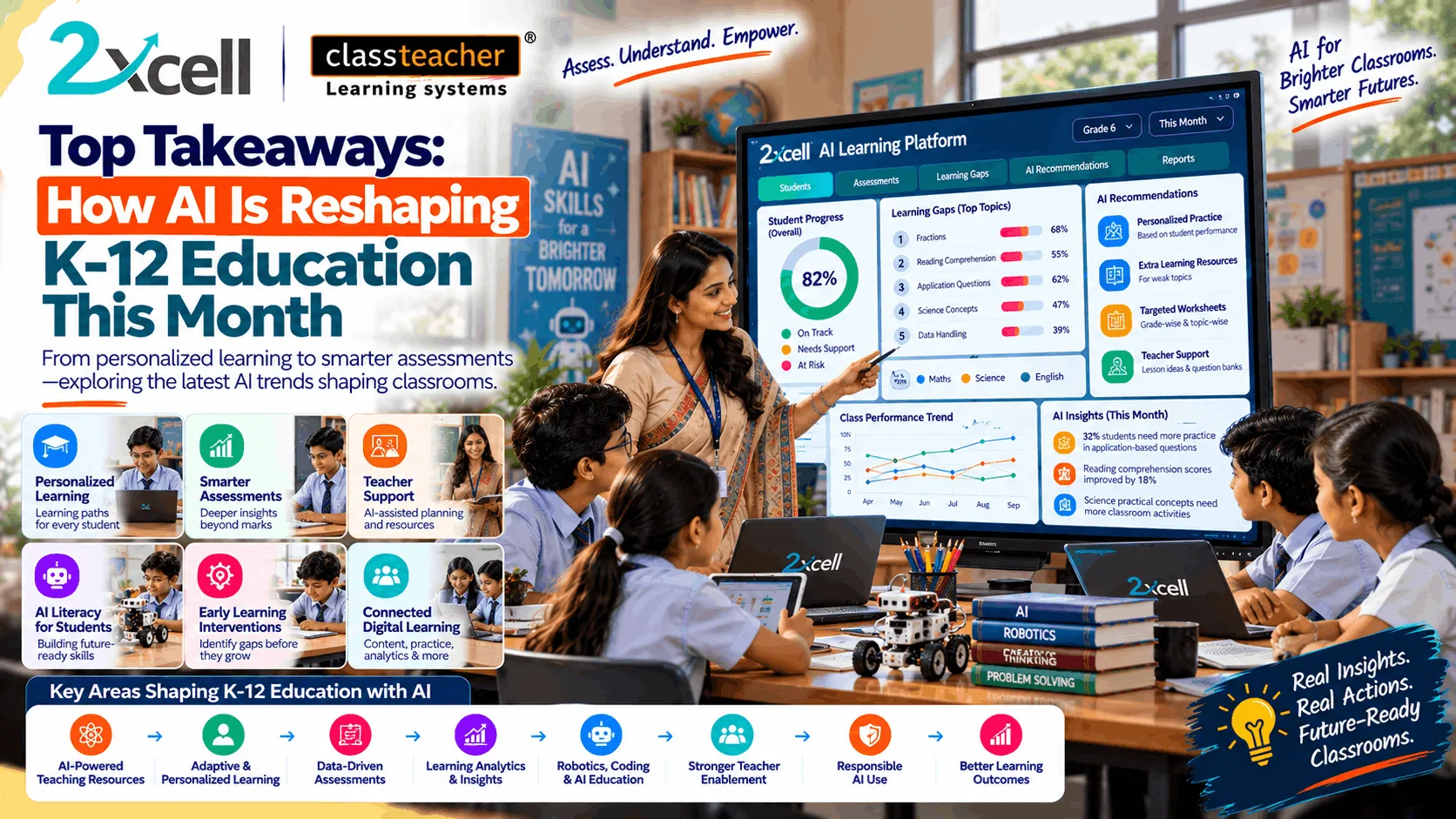
Introduction
Artificial Intelligence is becoming an increasingly important part of the conversation around K-12 education, from primary classrooms to senior secondary schools. Schools are exploring how AI can support lesson preparation, personalized practice, assessment, academic monitoring, and the development of future-ready skills.
The biggest change is not simply the introduction of new digital tools. It is the opportunity to make learning more responsive, help teachers use their time effectively, and give school leaders better information for academic decisions.
However, AI adoption looks different across schools. Some institutions are experimenting with AI-assisted teaching resources, while others are evaluating digital learning platforms, coding programs, analytics, and automated assessment support.
This month's key takeaways focus on the major ways AI is influencing K-12 education, the opportunities schools can explore, and the considerations that matter when turning these developments into practical classroom improvements.
1. AI Is Moving Beyond a Technology Experiment
AI in education is no longer discussed only as a future possibility. Schools and educators are exploring practical applications that can support everyday academic work.
These applications may include:
- Preparing draft lesson plans and worksheets.
- Creating practice questions at different difficulty levels.
- Organizing digital learning resources.
- Supporting revision and concept explanations.
- Reviewing assessment patterns.
- Helping teachers plan follow-up activities.
For example, a teacher preparing a lesson on fractions may use an AI tool to draft examples for students who need foundational practice and more challenging questions for students who have already mastered the basics.
The teacher must still review the content for accuracy, suitability, and curriculum alignment.
Key takeaway: The value of AI depends on how effectively it addresses a real teaching or learning need.
2. Personalized Learning Is Becoming a Major Priority
Students in the same grade may have different levels of understanding, learning gaps, and academic goals.
AI-supported learning systems can help organize resources and practice activities according to student performance, where these features are available.
A personalized learning journey might include:
- Reviewing the student's current understanding.
- Identifying concepts that need additional practice.
- Recommending relevant learning resources.
- Adjusting the level of practice.
- Reviewing progress after further learning.
For example, one student may need to revise basic algebraic operations, while another is ready to work on equations involving multiple steps.
Both students can work towards the same curriculum objective while receiving different levels of support.
Personalization should remain flexible. Students should not be permanently categorized by a single test result or automated recommendation.
Key takeaway: AI can help schools explore more responsive learning pathways without abandoning common academic standards.
3. Teachers Remain Central to AI-Powered Education
AI can assist with selected teaching tasks, but effective education requires much more than generating content or analysing scores.
Teachers understand classroom context, student behaviour, emotional needs, misconceptions, and the reasons behind individual difficulties.
AI tools may help teachers prepare resources or identify patterns, while teachers decide how to respond.
For instance, an AI tool may generate a worksheet for a science topic. The teacher must determine whether the questions are accurate, age-appropriate, aligned with the curriculum, and suitable for the class.
Schools should therefore focus on teacher-AI collaboration rather than treating AI as a replacement for professional judgement.
Useful priorities include:
- Training teachers to evaluate AI-generated content.
- Establishing guidelines for responsible use.
- Encouraging experimentation with clear learning objectives.
- Sharing effective classroom practices.
- Preserving teacher control over academic decisions.
Key takeaway: AI is most useful when it strengthens teacher capability and supports better instructional decisions.
4. Assessment Is Becoming More Insight-Oriented
Traditional grades can show how a student performed, but they do not always explain why the student struggled.
AI-supported and digital assessment tools can help organize performance information, highlight recurring errors, and identify topics that may require additional attention.
Depending on the platform, teachers may be able to review:
- Topic-wise performance.
- Question-level accuracy.
- Common misconceptions.
- Changes in performance over time.
- Areas requiring further practice.
Imagine that students perform well in basic science definitions but struggle to apply those concepts to practical questions. This information could encourage teachers to introduce more experiments, demonstrations, or application-based activities.
Assessment becomes more valuable when the results guide the next teaching step.
Key takeaway: The purpose of assessment is not only to assign marks; it is also to understand learning and decide what should happen next.
5. AI Is Helping Schools Explore Early Learning Support
Academic difficulties can develop gradually. A student who struggles with one foundational concept may find several later topics increasingly difficult.
AI-supported analytics may help schools identify patterns in assessment results, practice activity, and learning progress that deserve further investigation.
For example, repeated difficulties with reading comprehension may indicate that a student needs additional vocabulary practice or guided reading support.
Schools can use these insights to consider timely interventions, such as:
- Additional teacher-led explanations.
- Targeted practice activities.
- Small-group learning sessions.
- Revision of foundational concepts.
- Follow-up assessments.
AI predictions should never be treated as definitive judgments about a student's future performance. Teachers need to consider individual circumstances and verify concerns before deciding on support.
Key takeaway: Earlier identification can create more opportunities to support students before learning gaps become harder to address.
6. Digital Learning and AI Are Becoming More Connected
Schools often use different tools for content delivery, assessments, assignments, and academic reporting. Managing these separately can make it difficult to maintain a connected view of student progress.
Integrated digital learning environments can help bring multiple learning activities together.
A connected system may include:
- Curriculum-aligned content.
- Digital practice.
- Assessments.
- Learning analytics.
- Personalized recommendations.
- Student progress tracking.
For example, students can review a concept through digital content, complete a practice activity, take an assessment, and revisit areas where additional support is required.
The objective is to make the learning process more continuous rather than treating each activity as an isolated task.
Key takeaway: Schools should evaluate whether their digital tools work together to support the complete learning journey.
7. AI Literacy Is Becoming Relevant for Students
Students need opportunities to understand AI, not merely use AI-powered applications.
AI literacy can help learners explore how intelligent systems work, what they can do, where they may fail, and why their outputs need evaluation.
Age-appropriate AI education may cover:
- Basic AI concepts.
- Data and pattern recognition.
- Computational thinking.
- Coding and problem-solving.
- Responsible technology use.
- Bias, accuracy, and digital ethics.
For younger students, this may involve simple activities that demonstrate patterns and logical instructions. Older students can explore more advanced topics such as machine learning, data science, and responsible AI applications.
Hands-on projects can make these concepts easier to explore.
Key takeaway: Preparing students for an AI-enabled world involves developing understanding, critical thinking, and responsible use—not just familiarity with tools.
8. Robotics and Coding Continue to Offer Practical Learning Opportunities
Robotics and coding can connect classroom concepts with practical experimentation.
Students can design solutions, test instructions, identify errors, and improve their projects through repeated attempts.
These activities may support:
- Logical reasoning.
- Computational thinking.
- Creativity.
- Collaboration.
- Problem-solving.
- Practical application of STEM concepts.
For example, students building a simple sensor-based robot can explore how inputs, instructions, and outputs work together.
AI-related concepts can be introduced progressively, depending on students' ages and the school's curriculum.
Schools should ensure that activities have clear learning objectives and that teachers have the equipment and training required to guide them.
Key takeaway: Practical technology education can help students move from consuming technology to understanding and creating with it.
9. Responsible AI Use Is Becoming Essential
AI creates opportunities, but schools also need to address accuracy, privacy, fairness, and academic integrity.
Students may receive incorrect information from an AI tool. Teachers may encounter generated content that contains factual errors or inappropriate examples. Digital systems may also process sensitive student information.
Schools should establish clear expectations for responsible use.
Important considerations include:
- Protecting student information.
- Reviewing AI-generated educational content.
- Explaining acceptable and unacceptable uses.
- Teaching students to verify information.
- Preventing inappropriate dependence on automated answers.
- Understanding how digital platforms handle data.
- Ensuring accessibility and fairness.
Students should learn to question AI outputs, compare information with reliable sources, and explain their reasoning rather than accepting generated answers automatically.
Key takeaway: Responsible AI adoption requires clear policies, informed teachers, and age-appropriate student guidance.
10. Measuring Educational Impact Matters More Than Tool Adoption
Introducing an AI tool does not automatically improve learning.
Schools need to determine whether the technology is producing meaningful benefits for students and teachers.
Possible indicators include:
- Changes in assessment performance.
- Improvement in topic understanding.
- Student participation.
- Completion of targeted practice.
- Teacher preparation time.
- Usefulness of academic insights.
- Student and teacher feedback.
For example, a school testing an AI-assisted practice platform could compare students' understanding before and after an intervention, while also gathering teacher feedback about the quality of the resources.
A small pilot can help schools evaluate suitability before expanding implementation.
The evaluation should account for other factors that may influence learning, rather than attributing every change to the technology.
Key takeaway: Successful AI adoption should be evaluated through educational outcomes, usability, and responsible implementation—not simply the number of tools introduced.
How 2xcell Can Support AI-Enabled Learning
2xcell AI Learning Platform by CLASSTEACHER Learning Systems can form part of a school's broader digital learning strategy.
A connected learning environment can bring together relevant digital content, practice, assessments, analytics, personalized learning, and student progress tracking, depending on the features available and implemented.
A structured learning journey can follow:
Learn → Practise → Assess → Analyse → Support → Improve
For example, schools can use relevant learning information to review student progress, identify topics that may require additional practice, and plan suitable follow-up activities.
When evaluating 2xcell or any AI-supported learning platform, schools should examine curriculum alignment, actual platform capabilities, data privacy, teacher usability, and the quality of academic insights provided.
The objective is to support teachers and students with useful digital tools while keeping educators involved in important learning decisions.
What Schools Should Prioritize Next
Rather than adopting every new AI tool, schools can begin with a clear implementation plan.
- Identify a real need: Choose a challenge, such as assessment analysis, learning gaps, or lesson preparation.
- Evaluate suitable tools: Review educational value, accuracy, privacy, accessibility, and cost.
- Prepare teachers: Provide training and clear guidance for classroom use.
- Run a pilot: Test the tool in selected classes or subjects.
- Measure outcomes: Review student progress, teacher feedback, and practical usability.
- Refine the approach: Address weaknesses before expanding the initiative.
This creates a practical cycle:
Identify → Evaluate → Implement → Measure → Improve
Conclusion
AI is influencing K-12 education by creating new possibilities for personalized learning, assessment, early academic support, teacher assistance, digital learning, and technology education.
The most important takeaway is that successful adoption depends on more than access to AI tools. Schools need clear educational objectives, trained teachers, reliable digital resources, responsible data practices, and meaningful ways to evaluate results.
AI should help educators understand learning needs, explore suitable resources, and make better-informed decisions—not replace the professional judgement and human connection that education depends on.
With 2xcell AI Learning Platform by CLASSTEACHER Learning Systems, schools can explore a connected approach to digital content, practice, assessment, analytics, and student progress tracking as part of their wider digital learning strategy.
The future of K-12 education will be shaped not simply by how much AI schools use, but by how thoughtfully they use it to improve teaching and learning.
Smarter Technology. Stronger Teaching. Future-Ready Learning.