Introduction
Keeping students engaged throughout a lesson is one of the ongoing challenges in education. Even when a topic is important, students may lose concentration if learning becomes repetitive, passive, or disconnected from their interests.
Teachers need ways to encourage participation, sustain curiosity, and help students remain involved in the learning process.
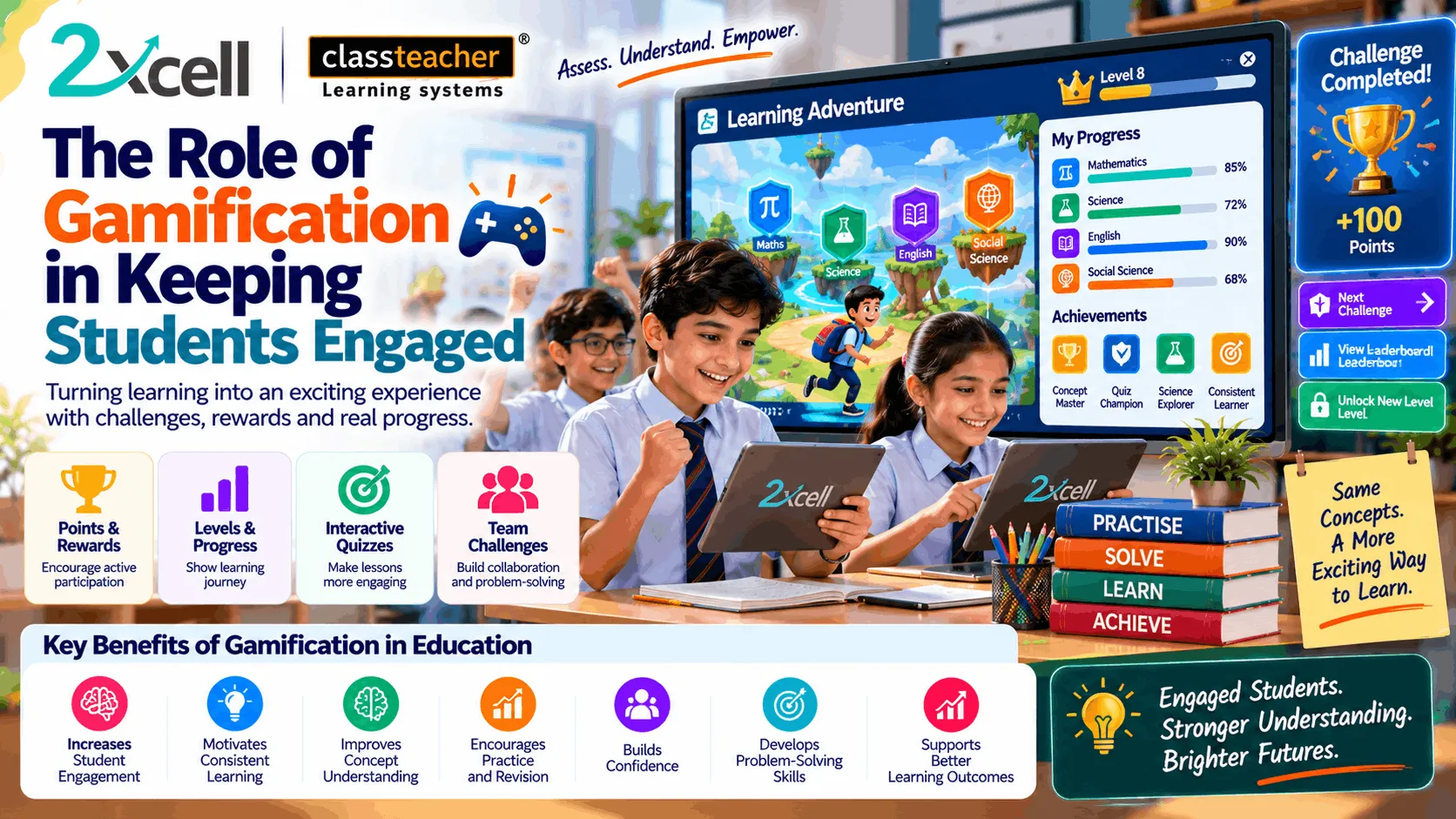
Gamification in education offers one approach by incorporating selected game elements into educational activities. Points, challenges, progress indicators, achievement badges, quizzes, and learning levels can make academic tasks more interactive while keeping the learning objective at the centre.
The idea is not to turn every lesson into a game. It is to give students meaningful reasons to participate, practise, solve problems, and continue learning.
A gamified learning experience can follow:
Challenge → Participation → Feedback → Progress → Achievement → Further Learning
When designed thoughtfully, gamification can help create a classroom environment where students are active participants rather than passive observers.
What Is Gamification in Education?
Gamification is the use of game-inspired elements in a non-game activity to encourage participation and support specific goals.
In education, these elements can be incorporated into lessons, quizzes, assignments, assessments, and classroom activities.
Common gamification elements include:
- Points for completing learning activities
- Badges for achieving specific learning goals
- Levels that represent progress
- Challenges based on academic concepts
- Progress bars and completion indicators
- Interactive quizzes and puzzles
- Team-based learning activities
- Achievement milestones
- Instant feedback
- Goal-oriented learning tasks
For example, a teacher teaching fractions could introduce a series of challenges in which students solve problems, receive feedback, and progress towards a defined learning goal.
The mathematics remains the same. The experience becomes more participatory.
Why Student Engagement Matters
Student engagement involves more than paying attention during a lesson. It includes participation, curiosity, effort, persistence, and willingness to work through difficult concepts.
When students actively engage with learning, they receive more opportunities to ask questions, practise skills, identify mistakes, and apply knowledge.
Engagement can support:
- Active classroom participation
- Concept exploration
- Regular practice
- Problem-solving
- Collaboration
- Independent learning
- Persistence with challenging tasks
- Reflection on progress
However, engagement alone does not guarantee academic improvement. Learning activities must also help students achieve clear educational objectives.
Gamification can be useful when it connects participation with meaningful learning.
1. Challenges Give Students a Clear Learning Goal
Students may find it easier to participate when they understand what they are trying to achieve.
Gamified activities can divide a larger learning objective into smaller, manageable challenges.
For example, a science lesson could include three stages:
Stage 1: Identify the parts of a plant.
Stage 2: Explain the function of each part.
Stage 3: Apply the concept to a real-life example.
Each stage builds on the previous one, helping students work towards a broader understanding.
Instead of facing a long activity without clear milestones, students can focus on one goal at a time.
2. Points Can Encourage Active Participation
Points can be awarded for completing educational activities, answering questions, solving problems, or demonstrating improvement.
For example, a classroom quiz could award points for correct answers, while a project-based activity could recognize research, collaboration, and problem-solving.
The important consideration is how points are used.
If students receive recognition only for answering quickly or outperforming classmates, some learners may feel discouraged.
A more balanced system can recognize effort, progress, accuracy, and persistence.
Points should reinforce learning behaviours rather than become the sole reason for participation.
3. Achievement Badges Can Recognize Learning Milestones
Badges provide a visual way to recognize specific accomplishments.
A student might earn a badge for completing a chapter, mastering a set of concepts, improving assessment accuracy, or finishing a challenging activity.
Examples include:
- Concept Master
- Problem-Solving Champion
- Consistent Learner
- Science Explorer
- Revision Achiever
- Coding Creator
These achievements can help students see the progress they are making.
Badges are most meaningful when they represent a real learning milestone rather than simply rewarding activity completion.
4. Progress Indicators Help Students See Their Improvement
Long-term learning goals can feel difficult when progress is not visible.
Progress bars, completed-task indicators, and chapter trackers can show students how far they have progressed towards a target.
For example, a student preparing for a Mathematics test may see that six of eight planned topics have been completed.
This information can help the student identify the remaining work and plan the next study session.
Progress indicators can also help teachers understand which activities have been completed and where additional support may be needed.
The focus should be on progress towards learning objectives, not merely the number of screens viewed or tasks opened.
5. Interactive Quizzes Make Lessons More Participatory
Quizzes can introduce questions, feedback, and short challenges into classroom instruction.
Instead of waiting until the end of a chapter to assess understanding, teachers can use quick quizzes during a lesson.
For example, after explaining a concept in Physics, a teacher can present a question and ask students to select the correct answer.
The responses can help reveal whether the class is ready to move forward or needs another explanation.
Interactive quizzes can support:
- Retrieval of previously learned information
- Quick checks of understanding
- Classroom participation
- Identification of misconceptions
- Immediate discussion of answers
The value lies in what students and teachers do with the responses afterwards.
6. Levels Can Structure Learning Progression
Levels can organize activities from foundational understanding to more advanced application.
For example, a coding activity might follow this structure:
Level 1: Understand — Learn the basic commands.
Level 2: Practise — Complete simple coding exercises.
Level 3: Debug — Identify and correct errors.
Level 4: Create — Build a small working project.
Students progress by demonstrating the required skills rather than simply spending time on the platform.
This approach can help teachers create a more structured sequence of learning tasks while allowing students to see the next achievable goal.
7. Team Challenges Can Encourage Collaboration
Not all gamification needs to be competitive at an individual level.
Team-based activities can encourage students to discuss ideas, explain their reasoning, and solve problems together.
For example, a classroom may divide students into small groups and ask each group to solve a series of science questions or complete a subject-based puzzle.
Students can contribute through different strengths, such as research, explanation, calculation, or presentation.
Team challenges can support:
- Communication
- Collaboration
- Shared problem-solving
- Peer learning
- Listening to different perspectives
- Collective responsibility
Teachers should ensure that every student has an opportunity to contribute instead of allowing one learner to complete the entire task.
8. Instant Feedback Helps Students Learn From Mistakes
Feedback is an essential part of meaningful gamified learning.
When students answer a question incorrectly, a well-designed activity can explain the mistake, provide a hint, or direct them towards the relevant concept.
For example, a student solving a mathematics puzzle might receive a hint about the formula required for the next step.
The process becomes:
Attempt → Feedback → Understand → Retry → Improve
This encourages students to treat mistakes as opportunities to learn rather than as reasons to stop participating.
For complex answers and descriptive work, teacher feedback remains important because automated systems may not fully understand the student's reasoning.
9. Gamification Can Encourage Students to Persist With Difficult Tasks
Some students stop participating when a concept becomes challenging.
Breaking a complex task into smaller stages can make it easier to approach.
For example, a difficult problem-solving activity can provide progressive hints or intermediate goals. Students can attempt each stage before moving towards the complete solution.
This creates a more manageable learning experience.
However, the challenge must remain appropriate for the student's ability. If activities are consistently too difficult, too easy, or frustrating, gamification may reduce rather than improve engagement.
Teachers should adjust the activity based on student responses and understanding.
10. Story-Based Learning Can Make Concepts More Meaningful
Stories can provide a context in which students use academic knowledge to complete a task.
For example, a geography activity could ask students to plan a journey using maps, distances, climate information, and available resources.
A mathematics activity might involve managing a fictional budget or calculating the materials required for a project.
A science challenge could ask students to investigate an environmental problem and select an appropriate solution.
The learning journey becomes:
Scenario → Investigation → Decision → Application
Story-based activities can make abstract concepts more relatable when the scenario is appropriate for the students' age and curriculum.
11. Gamification Can Support Different Academic Subjects
Gamification is not limited to mathematics or computer science. It can be adapted to many subjects.
Mathematics
Students can complete calculation challenges, solve puzzles, and progress through problem-solving levels.
Science
Students can investigate scenarios, predict outcomes, identify processes, and complete concept-based quizzes.
Languages
Vocabulary games, grammar challenges, reading activities, and sentence-building tasks can support language practice.
Social Science
Students can explore historical timelines, solve map-based challenges, or investigate events through structured activities.
Computer Science
Coding challenges, debugging exercises, and project milestones can make technical learning more interactive.
Environmental Education
Students can complete sustainability challenges, analyze real-world situations, and suggest practical solutions.
In each subject, the game element should reinforce the concept being taught.
12. Gamified Revision Can Make Practice More Engaging
Revision is essential, but repeatedly reviewing the same notes can become monotonous for some students.
Gamified revision can introduce variety through quizzes, timed challenges, matching activities, and topic-based milestones.
For example, students preparing for an examination can complete a set of chapter questions and then review their incorrect answers before attempting the next challenge.
A revision sequence might look like:
Recall → Answer → Check → Correct → Practise Again
Timed activities can be useful for developing examination readiness, but they should not be used for every task. Some concepts require careful reasoning rather than speed.
The purpose is to strengthen understanding, not create unnecessary pressure.
13. Gamification Can Help Teachers Identify Learning Difficulties
Responses to gamified activities can provide teachers with useful information about student understanding.
Depending on the digital platform, teachers may be able to review:
- Questions frequently answered incorrectly
- Concepts requiring additional explanation
- Activities students have completed
- Patterns in assessment performance
- Areas where practice is still needed
- Changes in performance over time
For example, if many students struggle with the same concept in a quiz, the teacher can pause the activity and explain the topic differently.
The relationship becomes:
Student Responses → Learning Insights → Teacher Action → Targeted Support
The data should inform teaching decisions rather than be treated as a complete measure of a student's ability.
14. Personalized Challenges Can Support Different Learning Needs
Students in the same classroom may require different levels of practice.
Gamified activities can be organized into foundational, intermediate, and advanced challenges.
For example:
Student A: Works on basic concept questions.
Student B: Practises standard application problems.
Student C: Attempts advanced questions that require deeper reasoning.
All students can work towards the same learning objective while completing tasks suited to their current level of understanding.
Teachers should monitor whether the challenges are appropriate and provide additional explanation whenever required.
15. Gamification Can Make Learning Progress More Visible to Students
Students may not always recognize improvement when they focus only on examination marks.
A learning dashboard can show completed goals, skills practised, milestones achieved, and areas that remain unfinished.
This can help students reflect on their learning journey.
For example, a student might discover that regular practice has improved accuracy in a topic that was previously difficult.
Such visibility can encourage students to set realistic goals and identify the next steps in their preparation.
Progress tracking should emphasize personal improvement rather than constant comparison with other students.
16. Gamification Can Encourage Independent Learning
Students often need to continue learning outside classroom hours.
A structured digital challenge can help them decide what to practise next and monitor their own progress.
For example, a student may complete a chapter quiz, review incorrect answers, and then attempt a related activity.
This encourages a simple cycle:
Set a Goal → Complete an Activity → Review Results → Choose the Next Step
Teachers and parents can support students by helping them set realistic goals and maintain a balanced study routine.
Independent learning should remain flexible enough to accommodate rest, other academic responsibilities, and individual circumstances.
17. Gamification Should Recognize More Than Winning
Leaderboards can introduce competition, but they are not suitable for every classroom or every student.
If recognition depends entirely on ranking, students who need more time or additional support may feel excluded.
Schools can consider alternative recognition methods, such as:
- Personal improvement milestones
- Consistent participation
- Completion of learning goals
- Team contributions
- Creative problem-solving
- Progress in a previously difficult topic
This creates opportunities for students to experience achievement without requiring everyone to compete for the same position.
A supportive learning environment should value improvement as well as high performance.
18. Digital Platforms Can Connect Gamification With Academic Progress
Gamification becomes more useful when activities are connected with curriculum objectives, practice, and assessment.
A digital learning environment may combine quizzes, interactive content, progress indicators, and assessment reports.
This can help teachers see whether students are participating and whether that participation is associated with improved understanding.
For example, after a gamified activity on a science topic, students can complete a short assessment to check what they have learned.
The goal is to evaluate learning outcomes, not simply count points, badges, or completed levels.
19. How 2xcell Can Support Interactive Digital Learning
2xcell AI Learning Platform by CLASSTEACHER Learning Systems can support a connected digital learning environment involving learning content, practice, assessments, analytics, personalized learning, and student progress tracking.
These elements can provide a foundation for organizing engaging learning activities around academic goals.
A connected learning cycle can follow:
Learn → Interact → Practise → Assess → Analyse → Improve
For example, schools can combine digital learning content with practice activities and assessments, then use relevant performance information to identify topics that may require additional attention.
The suitability of specific gamification features depends on the capabilities of the platform and how schools implement them.
The objective is to connect student participation with meaningful learning, rather than adding game elements without a clear academic purpose.
20. How Schools Can Implement Gamification Effectively
Schools can introduce gamification through a structured approach.
Step 1: Define the Learning Objective
Identify the concept or skill students should understand after completing the activity.
Step 2: Select an Appropriate Game Element
Choose a quiz, challenge, progress indicator, team task, or achievement milestone that supports the objective.
Step 3: Set Clear Rules
Explain how students participate, how progress is measured, and what they are expected to learn.
Step 4: Keep Challenges Appropriate
Make activities achievable while providing opportunities for deeper thinking and improvement.
Step 5: Provide Useful Feedback
Help students understand their mistakes and decide what to practise next.
Step 6: Include Every Learner
Avoid designing activities that reward only speed, prior knowledge, or competition.
Step 7: Review Learning Outcomes
Use student responses, assessments, and teacher observations to determine whether the activity was educationally useful.
This creates a practical implementation cycle:
Plan → Engage → Observe → Give Feedback → Assess → Refine
Avoiding Common Gamification Mistakes
Gamification can lose its educational value when the design focuses more on entertainment than learning.
Schools should avoid several common problems.
Rewarding Speed Alone: Fast answers do not always indicate deep understanding.
Overusing Competition: Constant rankings can discourage some learners.
Adding Unnecessary Rewards: Points and badges should have a clear connection to the learning activity.
Ignoring Learning Objectives: An engaging activity may still be ineffective if it does not teach or reinforce the intended concept.
Overloading Students: Too many notifications, animations, or challenges can distract from learning.
Ignoring Accessibility: Activities should account for students' different needs, abilities, and access to technology.
Effective gamification balances participation, clarity, challenge, feedback, and academic purpose.
How Schools Can Measure the Effectiveness of Gamification
Schools should evaluate whether gamified activities are helping students learn, not simply whether students enjoy them.
Useful indicators may include:
- Participation rates
- Activity completion
- Accuracy of answers
- Improvement in concept assessments
- Reduction in repeated mistakes
- Retention of concepts over time
- Quality of student explanations
- Application of knowledge to new problems
- Student feedback
- Teacher observations
For example, a school could compare students' understanding before an activity with their performance afterwards and conduct a follow-up assessment later.
This provides a more meaningful indication of whether gamification is supporting learning.
The central question is:
Are students remembering, understanding, and applying concepts more effectively?
The Future of Gamification in Education
As digital learning and AI-supported educational tools develop, gamification may become more closely connected with personalized practice, assessment, and learning analytics.
A future learning experience could follow:
Learning Goal
↓
Interactive Challenge
↓
Student Response
↓
Feedback and Guidance
↓
Personalized Practice
↓
Assessment
↓
Progress Review
↓
Next Learning Goal
This can create a more responsive learning environment in which students receive engaging opportunities to practise and teachers can use relevant information to guide instruction.
The future of educational gamification should focus on meaningful participation, stronger understanding, and sustained learning habits.
Conclusion
Gamification can help make education more interactive by introducing challenges, progress indicators, quizzes, achievements, and collaborative activities into the learning process.
When these elements are connected to clear academic objectives, they can encourage participation, provide opportunities for practice, and help students understand their progress.
However, effective gamification is not about turning every classroom activity into a competition. It is about creating learning experiences that encourage students to think, participate, learn from mistakes, and continue improving.
With 2xcell AI Learning Platform by CLASSTEACHER Learning Systems, schools can explore a connected approach to digital learning, practice, assessments, analytics, and student progress tracking.
The goal is to move beyond simply keeping students busy and towards helping them become active, curious, and motivated learners.
Make Learning Engaging. Make Progress Meaningful. Make Every Challenge Count.
2xcell AI Learning Platform
By CLASSTEACHER Learning Systems
Empowering Education with AI & Innovation.