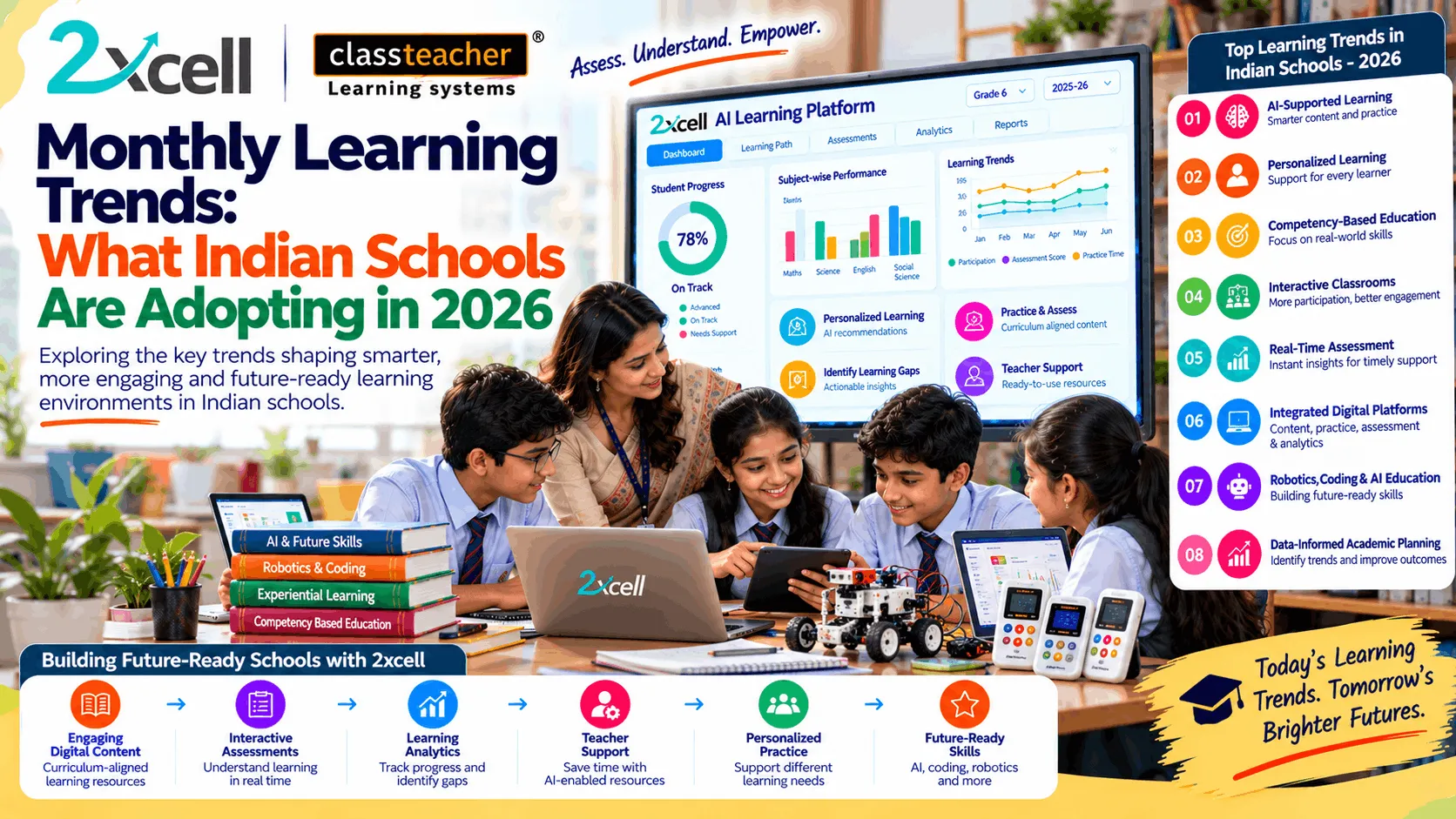
Introduction
Indian schools are navigating a period of change in which technology, teaching practices, assessment methods, and student expectations are influencing how education is delivered.
In 2026, schools are increasingly exploring ways to make learning more interactive, monitor academic progress more effectively, strengthen digital infrastructure, and prepare students for a technology-driven future. However, adoption varies considerably depending on a school's budget, infrastructure, leadership priorities, and teacher readiness.
The conversation is no longer limited to whether a school should introduce digital learning. A more important question is how technology can improve everyday teaching and create meaningful learning outcomes.
From AI-supported learning resources to competency-based assessments, robotics activities, teacher development, and data-informed academic planning, several trends are shaping discussions around modern school education.
This article explores the major learning trends Indian schools are adopting or evaluating in 2026, along with practical considerations for implementing them effectively.
1. AI-Supported Learning Is Becoming an Important Discussion
Artificial Intelligence is creating new possibilities for how schools prepare learning resources, support practice, and review student performance.
Schools are exploring AI tools for activities such as:
- Preparing draft lesson resources and practice questions.
- Generating additional explanations for difficult concepts.
- Supporting personalized revision.
- Organizing learning content.
- Analysing assessment patterns.
- Helping teachers identify topics that need further attention.
For example, a teacher teaching fractions may use an AI tool to draft foundational, intermediate, and advanced practice questions. After reviewing their accuracy and suitability, the teacher can use them to support students with different levels of understanding.
The key trend is not simply introducing AI into classrooms. It is identifying where AI can save preparation time, support teachers, and make learning more responsive.
Schools should also establish clear guidelines for accuracy, student privacy, responsible use, and teacher supervision.
2. Personalized Learning Is Receiving Greater Attention
Students in the same classroom can have different levels of prior knowledge, confidence, and academic readiness.
A uniform teaching approach may not provide every student with the same level of support.
Personalized learning aims to provide suitable resources and practice opportunities according to individual learning needs.
Digital learning platforms can help schools organize:
- Grade-wise and topic-wise content.
- Different levels of practice questions.
- Revision resources.
- Learning-gap identification.
- Student progress information.
- Additional learning activities.
For example, one student may need to revisit a foundational mathematics concept, while another is ready to solve application-based problems.
Both students can work towards the same learning objective through different practice pathways.
Personalization should not mean permanently labelling students. Their needs can change as they learn, and teachers should remain involved in selecting appropriate support.
3. Competency-Based Education Is Influencing Assessment Practices
An important educational priority is helping students apply knowledge rather than relying only on memorization.
Competency-based learning emphasizes what students can understand, demonstrate, and do with the knowledge they acquire.
Schools can support this approach through:
- Application-based questions.
- Practical activities.
- Project-based assignments.
- Problem-solving exercises.
- Conceptual assessments.
- Real-world scenarios.
For example, rather than asking students only to memorize a mathematical formula, a teacher can ask them to apply it to a practical measurement problem.
Assessment then becomes a way to understand whether students can use a concept in different situations.
Schools need to align assessment design with curriculum objectives and provide teachers with appropriate training to evaluate these competencies.
4. Interactive Classrooms Are Moving Beyond Traditional Lectures
Digital screens alone do not make a classroom interactive. The real value comes when students actively participate in learning.
Schools are exploring tools and activities such as:
- Live classroom quizzes.
- Interactive presentations.
- Digital polls.
- Simulations and demonstrations.
- Collaborative problem-solving.
- Student response systems.
For example, during a science lesson, a teacher can ask a question about renewable energy and collect responses from the class. The results can reveal whether students understand the concept or need another explanation.
Classteacher's Smart Clickers ecosystem is one example of technology designed to support interactive classroom assessments and student response collection.
The broader trend is towards making students active participants rather than relying entirely on one-way instruction.
5. Real-Time Assessment Is Helping Teachers Respond Faster
Traditional assessments often provide information after a test has been completed and evaluated. Real-time assessment tools can provide feedback during or shortly after classroom activities.
Depending on the system, teachers may be able to review:
- Overall class accuracy.
- Question-wise responses.
- Commonly selected incorrect answers.
- Individual student performance.
- Areas requiring revision.
Consider a class where most students answer a question incorrectly. The teacher can revisit the topic immediately instead of discovering the problem weeks later.
A practical learning cycle looks like this:
Teach → Ask → Collect Responses → Analyse → Explain → Reassess
These insights are most useful when teachers interpret them alongside classroom observations and the context of the lesson.
6. Digital Learning Platforms Are Becoming More Integrated
Schools may use separate tools for classroom content, online assessments, assignments, revision, and academic reporting. Managing disconnected systems can create additional work for teachers and administrators.
This is encouraging interest in more connected digital learning environments.
A well-organized platform may bring together:
- Curriculum-related learning content.
- Digital practice activities.
- Assessments.
- Student progress information.
- Learning analytics.
- Personalized learning resources.
The objective is to connect different stages of the learning process rather than treat every activity as a separate task.
For example, a student can study a concept, practise related questions, complete an assessment, and receive additional resources where required.
When evaluating a platform, schools should check its actual capabilities, curriculum alignment, usability, and compatibility with existing systems.
7. Robotics, Coding, and AI Education Are Gaining Importance
As technology influences more industries, schools are exploring ways to introduce students to computational thinking, coding, robotics, and Artificial Intelligence.
These activities can help students develop skills such as logical reasoning, experimentation, creativity, and problem-solving.
Depending on the grade level and available resources, schools may introduce:
- Block-based coding.
- Basic programming.
- Robotics projects.
- Sensor-based activities.
- AI concepts.
- Computational thinking challenges.
- Practical technology demonstrations.
For example, students building a simple robot can explore how instructions, sensors, and mechanical components work together.
The learning experience becomes more meaningful when students create, test, identify errors, and improve their projects rather than only watching demonstrations.
Schools should choose age-appropriate activities and ensure that practical programs are supported by trained educators and suitable equipment.
8. Data-Informed Academic Planning Is Becoming More Relevant
Schools generate academic information through tests, classroom activities, assignments, attendance systems, and digital learning tools.
When organized responsibly, this information can help teachers and school leaders identify patterns that require attention.
Academic dashboards may help schools review:
- Subject-wise performance.
- Grade-level trends.
- Topics requiring additional practice.
- Assessment outcomes.
- Student progress over time.
- Areas where additional academic resources may be useful.
For example, if several classes struggle with the same mathematics topic, the academic team may review the teaching resources, assessment design, or lesson sequence.
The purpose of data-informed planning is not simply to rank students or teachers. It is to understand what the information suggests and determine what action may improve learning.
Schools should avoid treating a single score or automated prediction as a complete picture of student ability.
9. Personalized Feedback Is Gaining Importance
A grade can indicate how a student performed, but it may not explain what the student understood, where mistakes occurred, or how to improve.
Personalized feedback focuses on providing more specific guidance.
For example, instead of reporting only that a student scored 65% in mathematics, a teacher might explain that the student understands basic calculations but needs more practice with fractions and word problems.
Digital tools can help organize question-wise performance and recommend relevant practice where supported.
Useful feedback should clarify:
- What the student did well.
- Which concept requires attention.
- Why an error may have occurred.
- What the student should practise next.
- How progress will be reviewed.
The teacher's role remains central in interpreting results, understanding individual circumstances, and deciding what support is appropriate.
10. Hybrid Learning Is Supporting Flexible Access to Resources
Hybrid learning combines classroom instruction with digital learning opportunities.
The exact model varies between schools. Some use online resources to reinforce classroom lessons, while others provide digital revision material, recorded explanations, or additional practice outside school hours.
A hybrid approach can support learning through:
- Classroom teaching.
- Digital learning content.
- Online revision resources.
- Independent practice.
- Follow-up assessments.
- Teacher-guided support.
For example, a teacher may explain a topic in class and then share a digital activity that allows students to revisit the concept at home.
The objective is to create continuity between classroom instruction and independent learning.
Successful implementation requires appropriate access to devices, clear learning expectations, and alternatives for students who face connectivity or accessibility challenges.
11. Teacher Training Is Becoming Essential to Digital Adoption
Introducing technology is only one part of school transformation. Teachers need the confidence and skills to use it effectively.
Training requirements may include:
- Digital lesson planning.
- Interactive classroom techniques.
- AI-assisted content preparation.
- Assessment design.
- Learning analytics.
- Digital classroom management.
- Responsible technology use.
- Student data protection.
For example, knowing how to generate an AI-assisted worksheet is not enough. A teacher also needs to evaluate its accuracy, difficulty, relevance, and alignment with the intended learning objective.
Schools can support continuous development through workshops, peer learning, mentoring, and opportunities to apply new methods in the classroom.
Technology is most useful when it strengthens teacher capability instead of adding complexity to an already demanding workload.
12. Foundational Literacy and Numeracy Remain Essential
Advanced digital tools cannot compensate for gaps in basic reading, writing, and mathematics.
Foundational literacy and numeracy provide the basis for learning across subjects and grade levels.
Schools can use a combination of classroom instruction, regular practice, assessments, and suitable digital resources to support these essential skills.
Examples include:
- Reading comprehension exercises.
- Vocabulary development.
- Number-sense activities.
- Arithmetic practice.
- Short formative assessments.
- Targeted revision.
- Teacher-led remedial support.
Digital platforms may help organize practice and show where students need additional attention.
However, progress depends on the quality of instruction, consistent support, appropriate materials, and the student's learning circumstances—not simply on using an application.
13. Gamification Is Being Explored to Encourage Participation
Gamification introduces selected game-like elements into learning activities.
These may include points, progress indicators, challenges, levels, badges, or classroom competitions.
When used appropriately, these features can encourage participation and give students clear short-term goals.
For example, a vocabulary activity may use progress indicators to help students track how many words they have practised.
However, gamification should not turn every lesson into a competition or make rewards more important than understanding.
Schools should prioritize meaningful learning, collaboration, and constructive feedback. The success of a gamified activity should be judged by its educational value rather than the number of points students earn.
14. Inclusive and Accessible Digital Learning Is Important
Schools serve students with different learning requirements, language backgrounds, levels of preparation, and access to technology.
Digital learning resources can offer additional formats, including text, audio, video, visual demonstrations, and interactive activities.
Where available, accessibility features can help students engage with material in ways that better suit their requirements.
Schools should consider:
- Accessibility for students with disabilities.
- Language options.
- Device and internet availability.
- Clear and readable content.
- Flexible practice opportunities.
- Teacher and support staff training.
A digital initiative should expand learning opportunities rather than exclude students who have limited access to devices or connectivity.
15. Parent-School Communication Is Becoming More Digital
Parents often want to understand their child's academic progress, attendance, upcoming activities, and areas that require support.
Digital communication systems can help schools share relevant information more consistently.
Depending on the system, schools may use digital channels for:
- Academic progress updates.
- Assignment information.
- Assessment schedules.
- Attendance notifications.
- Parent-teacher meeting coordination.
- Learning recommendations.
For example, a school can use a structured digital report to help parents understand which topics their child should revise before the next assessment.
Communication should remain purposeful and protect student information. Schools also need to consider families who may not have reliable access to digital communication channels.
16. School Leaders Are Evaluating Technology Through Learning Outcomes
An increasing focus on educational outcomes means schools need to consider whether technology is solving a real problem.
Before investing in a platform, school leaders can ask:
- Does it support the school's academic objectives?
- Does it improve the teaching or learning process?
- Can teachers use it without unnecessary complexity?
- Are the assessment and reporting features useful?
- Is the system accessible to students?
- What training and support will be required?
- How will the school evaluate its impact?
- Are the costs sustainable over time?
A small pilot can help a school test the platform before expanding its use.
For instance, a school could introduce an interactive assessment tool in selected classes, collect teacher feedback, examine student participation, and review the usefulness of the results.
This approach encourages evidence-based decisions rather than adopting technology simply because it is popular.
17. AI and Digital Tools Are Creating New Opportunities for Academic Support
AI can help schools organize learning information and identify areas where additional support may be useful.
Depending on the platform, AI-supported tools may assist with:
- Drafting practice questions.
- Recommending revision resources.
- Organizing learning content.
- Summarizing assessment patterns.
- Supporting personalized practice.
- Helping teachers prepare learning activities.
For example, if a student repeatedly struggles with a particular concept, a platform may recommend a relevant explanation or additional practice questions.
The teacher can review the recommendation and decide whether it suits the student's needs.
Schools should remember that AI-generated content can contain errors and that automated recommendations may not fully reflect a student's circumstances. Human review, transparency, and responsible data practices are essential.
18. How 2xcell Fits Into the Digital Learning Landscape
2xcell AI Learning Platform by CLASSTEACHER Learning Systems can be considered as part of a school's broader digital learning strategy.
A connected digital learning environment can bring together relevant learning content, practice, assessments, analytics, personalized learning, and student progress tracking.
These elements can support a structured learning journey:
Learn → Practise → Assess → Analyse → Support → Improve
For example, students can access learning resources, practise a concept, complete an assessment, and receive further learning support where appropriate.
Teachers can use available learning information to review performance and plan follow-up activities.
For schools evaluating digital platforms in 2026, the important consideration is whether the available features address their actual academic needs and integrate effectively with classroom teaching.
The platform should support the educational process, while teachers continue to guide instruction, interpret student needs, and make important academic decisions.
19. Challenges Indian Schools Should Consider in 2026
Although digital education offers opportunities, implementation is not equally straightforward for every school.
Several practical challenges need attention.
Infrastructure and connectivity: Schools require suitable devices, reliable connectivity where necessary, and technical support.
Teacher readiness: Staff need time and training to incorporate technology into their teaching.
Budget constraints: Licensing, hardware, maintenance, and professional development can add to the overall cost.
Content quality: Digital resources must be accurate, curriculum-aligned, and appropriate for the students using them.
Data privacy: Schools must protect student information and understand how technology providers process it.
Digital accessibility: Students should have fair opportunities to participate, including those with limited access to devices.
Measuring impact: Schools need to evaluate learning outcomes rather than relying only on usage statistics or the number of digital tools adopted.
A thoughtful implementation plan can help schools address these challenges and prioritize investments that provide genuine educational value.
20. What Indian Schools Can Prioritize Next
Schools do not need to adopt every emerging technology simultaneously. A practical strategy begins with clear educational priorities.
A useful implementation framework includes the following steps:
- Identify the need: Determine whether the priority is assessment, teacher workload, personalized learning, digital content, or academic monitoring.
- Review current practices: Understand existing infrastructure, teaching methods, and staff readiness.
- Choose suitable technology: Evaluate platforms against specific educational requirements.
- Train teachers: Provide practical guidance and ongoing support.
- Start with a pilot: Test the approach in selected classes or subjects.
- Measure results: Review learning progress, participation, teacher feedback, and implementation costs.
- Improve and expand: Refine the approach before introducing it more widely.
This creates a sustainable cycle:
Identify → Plan → Implement → Evaluate → Improve → Scale
The best technology strategy is not necessarily the one with the most features. It is the one that helps a school solve meaningful problems and improve its educational processes.
Conclusion
The learning landscape in Indian schools in 2026 is being shaped by growing interest in AI-supported learning, personalized practice, competency-based assessment, interactive classrooms, digital platforms, robotics, coding, and data-informed academic planning.
These developments offer schools new ways to support teachers, monitor learning, and provide students with more varied educational experiences. However, the value of any trend depends on how well it addresses the school's needs and supports meaningful learning outcomes.
Effective adoption requires trained teachers, appropriate infrastructure, curriculum alignment, responsible technology use, and continuous evaluation.
With 2xcell AI Learning Platform by CLASSTEACHER Learning Systems, schools can explore a connected approach to digital content, practice, assessment, analytics, personalized learning, and student progress tracking as part of their broader digital education strategy.
Ultimately, the future of school education is not about replacing traditional teaching with technology. It is about combining effective teaching with useful digital tools to create more engaging, informed, and supportive learning environments.
Smarter Learning. Empowered Teachers. Future-Ready Schools.
2xcell AI Learning Platform
By CLASSTEACHER Learning Systems
Empowering Education with AI & Innovation.