Introduction
Board examinations are an important academic milestone for students. Preparing for them requires more than memorizing textbook chapters or completing the syllabus before the examination date. Students need a clear understanding of concepts, regular revision, effective practice, time management, and the ability to apply their knowledge under examination conditions.
Traditional classroom teaching remains essential, but digital learning can provide additional opportunities for students to strengthen their preparation. Through structured digital content, practice questions, mock tests, interactive lessons, and performance tracking, students can approach board examinations with a more organized study routine.
Digital learning also helps students revisit difficult concepts, practise at their own pace, and identify areas that require additional attention.
A well-planned preparation journey can follow:
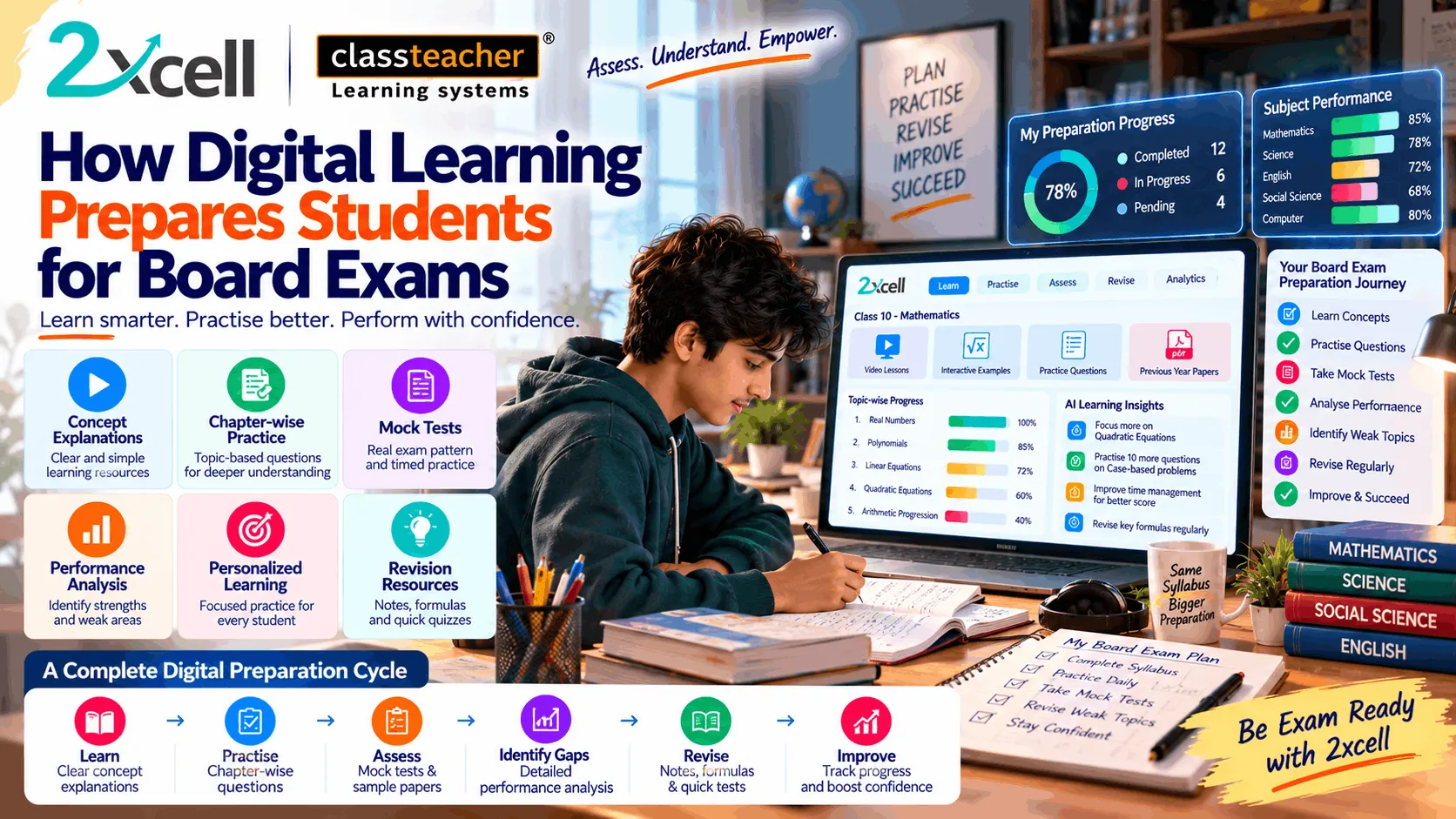
Learn → Practise → Assess → Identify Gaps → Revise → Improve
The objective is not to replace classroom teaching with technology. It is to combine teacher guidance with useful digital resources so students can prepare more effectively.
What Is Digital Learning for Board Exam Preparation?
Digital learning uses technology to make educational resources, practice activities, assessments, and revision materials accessible through digital platforms.
For board exam preparation, these resources may include:
- Digital lessons and concept explanations
- Curriculum-aligned learning materials
- Chapter-wise revision notes
- Practice questions and worksheets
- Mock examinations
- Interactive quizzes
- Video explanations
- Topic-wise assessments
- Performance reports
- Personalized practice recommendations
When these resources are organized around the relevant board syllabus and examination requirements, students can follow a more structured preparation process.
The usefulness of digital learning depends on the quality of the content, its curriculum alignment, and how effectively students and teachers use it.
1. Digital Learning Helps Students Organize Their Preparation
One of the challenges students face before board examinations is managing a large syllabus across multiple subjects.
Without a clear plan, students may spend too much time revising familiar chapters while overlooking difficult or unfinished topics.
Digital learning resources can help students organize preparation by subject, chapter, and topic.
For example, a student preparing for Class 10 examinations can divide Mathematics into individual chapters and track progress through each one.
A preparation tracker may include:
- Chapters completed
- Topics requiring revision
- Practice exercises attempted
- Assessments completed
- Remaining syllabus
- Upcoming revision goals
This approach helps students understand what has been completed and what still needs attention.
2. Students Can Revisit Difficult Concepts Whenever Needed
Not every concept becomes clear during the first classroom explanation.
Some students may need additional examples, a visual demonstration, or another explanation before they understand a topic.
Digital learning provides an opportunity to revisit available lessons and resources outside classroom hours.
For example, a student struggling with quadratic equations can review the concept, study worked examples, and attempt additional questions before moving to more advanced problems.
The process becomes:
Review the Concept → Understand the Example → Solve Questions → Check Understanding
This flexibility can help students strengthen their foundations before beginning full-length examination practice.
3. Chapter-Wise Practice Builds Examination Readiness
Completing a chapter is not the same as being ready to answer questions from it.
Students need opportunities to apply their understanding through different question formats.
Digital platforms can support chapter-wise practice through:
- Multiple-choice questions
- Short-answer questions
- Long-answer questions
- Numerical problems
- Case-based questions
- Application-oriented exercises
The specific question formats should reflect the student's board, class, subject, and current examination pattern.
Regular practice helps students become familiar with how concepts may be tested and where additional preparation is necessary.
4. Mock Tests Help Students Experience Examination Conditions
Mock tests are useful because they allow students to practise completing an examination within a defined time.
Students can use them to understand whether they are able to manage the question paper, allocate time appropriately, and attempt questions in a suitable sequence.
A digital preparation routine can include:
- Complete the relevant syllabus.
- Attempt a chapter-wise test.
- Review the incorrect answers.
- Revise the concepts that caused difficulty.
- Attempt a full-length mock paper.
- Compare performance across attempts.
Mock tests should follow the relevant board's syllabus, marking scheme, and examination pattern wherever possible.
Their purpose is not simply to generate a score. It is to help students identify what needs to improve before the actual examination.
5. Instant Feedback Helps Students Learn From Mistakes
When students practise questions, understanding why an answer is incorrect is as important as knowing the correct answer.
Some digital assessments can provide immediate feedback for objective questions and selected question types.
For example, a student may repeatedly make errors while solving percentage-based problems. Reviewing the feedback can help the student recognize whether the difficulty relates to calculations, formulas, or concept understanding.
The learning cycle becomes:
Attempt → Review the Answer → Understand the Mistake → Practise Again
For descriptive answers, numerical solutions requiring detailed steps, and other complex responses, teacher review remains important.
Digital feedback and teacher guidance can work together to make practice more meaningful.
6. Performance Analytics Help Identify Weak Chapters
An overall examination score does not always reveal the exact topics that need attention.
A student might perform well in most Mathematics chapters but struggle with geometry or statistics.
Topic-wise performance reports can provide a clearer picture of these differences.
For example:
Topic
Preparation Status
Algebra
Strong
Geometry
Needs revision
Statistics
Developing
Trigonometry
Additional practice required
Such a report can help students prioritize their revision instead of treating every chapter as equally difficult.
Teachers can also use this information to recommend targeted exercises or additional explanations.
7. Digital Revision Makes Study Sessions More Focused
Revision becomes more manageable when students divide it into smaller, specific tasks.
Instead of planning to revise an entire subject in one sitting, students can focus on a limited number of concepts and test their understanding after each session.
Digital revision resources may include:
- Chapter summaries
- Formula sheets
- Concept maps
- Flashcards
- Quick quizzes
- Important definitions
- Practice worksheets
- Topic-based revision videos
For example, a student revising Physics can review key formulas, solve related numerical questions, and finish with a short assessment.
This makes revision an active process rather than simply rereading notes.
8. Digital Learning Supports Different Subjects in Different Ways
Every subject has different preparation requirements. Digital learning becomes more useful when the resources match the nature of the subject.
Mathematics
Interactive examples, numerical practice, formula revision, and timed exercises can help students develop accuracy and problem-solving skills.
Science
Diagrams, animations, concept explanations, virtual demonstrations, and chapter-wise tests can help students understand processes and scientific principles.
English and Other Languages
Grammar exercises, reading comprehension, writing practice, vocabulary activities, and sample questions can support language preparation.
Social Science
Digital timelines, maps, structured notes, visual resources, and question-answer practice can help students revise historical events, geographical concepts, and other syllabus topics.
Computer Science
Coding exercises, worked examples, practical activities, and concept-based assessments can help students apply technical knowledge.
The format should always support the relevant syllabus and the learning objective.
9. Digital Resources Can Help Students Manage Their Study Time
Effective board preparation requires balancing several subjects without neglecting difficult areas.
Digital planners and progress trackers can help students organize their study sessions around realistic goals.
For example, a weekly plan might include:
- Mathematics practice on selected days
- Science concept revision and numerical exercises
- Language reading and writing practice
- Social Science chapter revision
- One or more timed practice sessions
- Review of previously incorrect answers
Students should also include breaks, sleep, and time for activities outside studying.
A balanced routine is generally more sustainable than relying on long, unplanned study sessions.
10. Digital Learning Can Support Self-Paced Preparation
Students may differ in their understanding of the syllabus and the amount of practice they need.
Some may be ready to solve advanced questions, while others need to strengthen basic concepts first.
Digital learning allows students to revisit available resources, repeat practice activities, and progress through topics according to their preparation needs.
For example:
Student A: Revises fundamental concepts before attempting standard questions.
Student B: Practises application-based questions after completing the basics.
Student C: Focuses on timed papers and more challenging problems.
All three students can work towards the same academic objectives while following different preparation paths.
11. Past Papers and Sample Papers Improve Familiarity With Question Formats
Past examination papers and official sample papers can help students understand the structure and style of board examinations.
Digital access makes these resources easier to organize and use alongside chapter-wise preparation.
Students can use them to:
- Identify frequently tested concepts
- Practise different question formats
- Understand the marking scheme
- Improve answer presentation
- Develop time-management strategies
- Recognize topics that need further revision
Students should use authentic papers and sample materials from the relevant board whenever possible.
They should also check the current syllabus and examination pattern rather than assuming that older papers always reflect current requirements.
12. Digital Learning Can Help Reduce Last-Minute Confusion
Last-minute preparation often becomes stressful when students are unsure about unfinished chapters, weak topics, or the amount of revision remaining.
A structured digital study plan can provide better visibility into preparation progress.
For example, a student may identify three chapters requiring further practice and schedule them across the remaining revision days.
This helps convert a general concern about the syllabus into specific tasks.
However, digital tools should support realistic planning rather than encourage students to study continuously without adequate rest.
13. Teachers Can Use Digital Assessment Results to Guide Students
Technology can provide useful information about student performance, but interpreting that information requires educational judgement.
Teachers can review assessment results to understand which concepts need further explanation and which students may benefit from additional support.
For example, if several students answer questions on the same topic incorrectly, the teacher may revisit the concept using a different example or teaching method.
The process becomes:
Assessment Results → Teacher Review → Targeted Explanation → Additional Practice
This allows digital assessment to support classroom instruction rather than operate separately from it.
14. Parents Can Better Understand Preparation Progress
Parents often want to know whether their child is preparing consistently and which areas need additional support.
Depending on the platform, digital progress reports can provide information about completed activities, assessment performance, and topics requiring revision.
This can help parents ask more useful questions, such as:
- Which chapter are you working on this week?
- Which topic is still difficult?
- Have you reviewed your incorrect answers?
- Would you like help planning your next study session?
The goal is to encourage constructive support without making every study session a discussion about marks.
15. Digital Learning Can Make Revision More Interactive
Reading notes is useful, but students also need to retrieve information and apply it.
Interactive quizzes, matching activities, concept-based questions, and digital exercises can make revision more active.
For example, after studying the human digestive system, students could label a diagram, arrange the stages of digestion, and answer questions about the function of different organs.
These activities provide opportunities to check understanding and identify concepts that need another review.
Interactive learning should remain connected to clear academic objectives rather than focusing only on entertainment.
16. AI Can Support More Targeted Board Exam Preparation
AI-enabled learning systems may use relevant assessment and practice information to recommend resources or identify areas where additional revision could be useful.
For example, if a student repeatedly struggles with a particular concept, an AI-supported platform may recommend related explanations or additional practice questions, depending on its capabilities.
A possible preparation cycle is:
Assess → Identify a Gap → Recommend Practice → Review Results → Adjust Support
These recommendations should be reviewed in context. AI-generated insights are not a substitute for checking the syllabus, verifying educational content, or seeking teacher guidance when a student continues to struggle.
17. Digital Preparation Can Help Students Track Improvement
Students may become discouraged when they judge their preparation only by one test result.
Tracking performance across several practice sessions can help them understand whether their accuracy, speed, or understanding is changing.
For example, a student can compare results from successive chapter tests and identify whether additional practice has helped.
Progress tracking can focus on:
- Accuracy
- Time taken
- Topic-wise performance
- Common mistakes
- Completion of revision goals
- Performance across mock tests
The purpose is to identify the next useful step, not to treat every score as a final judgment of ability.
18. Combining Digital Learning With Textbooks Is Important
Digital learning should complement the student's prescribed textbooks, class notes, and official examination resources.
Students should not assume that every online explanation or AI-generated answer is accurate or aligned with their syllabus.
A balanced preparation approach can combine:
Textbooks + Teacher Guidance + Digital Resources + Practice Papers + Revision
Students should prioritize prescribed material and official board guidance when deciding what to study.
Digital tools are most valuable when they help students understand, practise, and revise the required content more effectively.
19. What Schools Should Consider Before Adopting Digital Exam Preparation Tools
Schools should evaluate digital learning solutions according to their students' academic requirements.
Curriculum Alignment
Does the content match the relevant board, grade, subject, and syllabus?
Content Quality
Are explanations accurate, clear, and appropriate for the student's level?
Assessment Quality
Do practice questions reflect relevant concepts and examination requirements?
Progress Tracking
Can students and teachers identify areas requiring additional work?
Teacher Involvement
Can teachers review results and guide students when necessary?
Ease of Use
Can students access the resources without unnecessary complexity?
Data Privacy
Are student records managed with appropriate security and access controls?
Balanced Learning
Does the platform support classroom learning and independent practice without encouraging excessive screen time?
Evaluating these factors helps schools select tools that serve academic needs rather than adopting technology simply because it is available.
20. How 2xcell Can Support a Connected Digital Learning Environment
2xcell AI Learning Platform by CLASSTEACHER Learning Systems can support a connected digital learning environment involving learning content, practice, assessments, analytics, personalized learning, and student progress tracking.
These elements can help schools organize learning activities around a connected process:
Learn → Practise → Assess → Analyse → Support → Improve
For board exam preparation, schools can explore how relevant digital resources and assessment information fit into their existing teaching and revision processes.
For example, students may use available learning content to review a topic, complete practice activities, and assess their understanding. Teachers can then use relevant performance information to decide where further explanation or practice may be helpful.
The objective is to connect learning resources with meaningful practice and academic support while keeping teachers central to the preparation process.
Building an Effective Digital Board Exam Preparation Routine
Schools, teachers, and students can make digital learning more effective by following a practical routine.
Step 1: Review the Syllabus
Identify the chapters, topics, and learning objectives required for the examination.
Step 2: Plan the Preparation Schedule
Divide the syllabus into manageable study and revision sessions.
Step 3: Learn and Understand
Use textbooks, classroom instruction, and suitable digital resources to understand concepts.
Step 4: Practise Topic-Wise Questions
Attempt questions after completing each topic or chapter.
Step 5: Review Mistakes
Understand why answers were incorrect and revisit the related concepts.
Step 6: Take Mock Tests
Practise under timed conditions using appropriate sample papers.
Step 7: Analyse Progress
Identify strengths, unfinished topics, and areas requiring further work.
Step 8: Revise Strategically
Allocate additional time to difficult topics while maintaining revision of stronger areas.
This creates a more organized preparation cycle:
Plan → Learn → Practise → Review → Test → Improve
The Future of Digital Board Exam Preparation
As digital education develops, schools may increasingly combine structured learning content, interactive practice, assessment, and learning analytics within connected educational environments.
A future preparation journey could look like:
Curriculum-Aligned Content
↓
Chapter-Wise Learning
↓
Interactive Practice
↓
Assessment
↓
Performance Analysis
↓
Targeted Revision
↓
Mock Examination
↓
Progress Review
↓
Final Preparation
Such an approach can help students and teachers make preparation more organized and responsive to learning needs.
Technology alone does not guarantee examination success. Consistent effort, conceptual understanding, suitable practice, teacher guidance, and a healthy study routine remain essential.
Conclusion
Preparing for board examinations requires students to understand concepts, practise questions, revise regularly, manage time, and learn from mistakes.
Digital learning can support this process by making educational resources easier to access, providing structured practice, enabling mock assessments, and helping students identify topics that require additional attention.
When combined with prescribed textbooks, teacher guidance, and authentic examination resources, digital learning can make preparation more organized and purposeful.
With 2xcell AI Learning Platform by CLASSTEACHER Learning Systems, schools can explore a connected approach to digital learning, assessment, analytics, and student progress tracking.
The goal is not simply to complete the syllabus before the examination. It is to help students develop the understanding, preparation habits, and confidence needed to approach board examinations effectively.
Learn with Clarity. Practise with Purpose. Prepare with Confidence.
2xcell AI Learning Platform
By CLASSTEACHER Learning Systems
Empowering Education with AI & Innovation.