Introduction
Managing academic progress becomes more complex when a school teaches multiple grades and subjects simultaneously. Each grade follows different learning objectives, every subject develops different skills, and students progress at different rates.
For teachers, this means tracking more than examination marks. They need to understand which concepts students have mastered, where learning gaps exist, how performance changes over time, and which students may require additional support.
For school leaders, the challenge is broader. They need a clear view of academic progress across grades, subjects, sections, and classrooms without depending entirely on manually prepared reports.
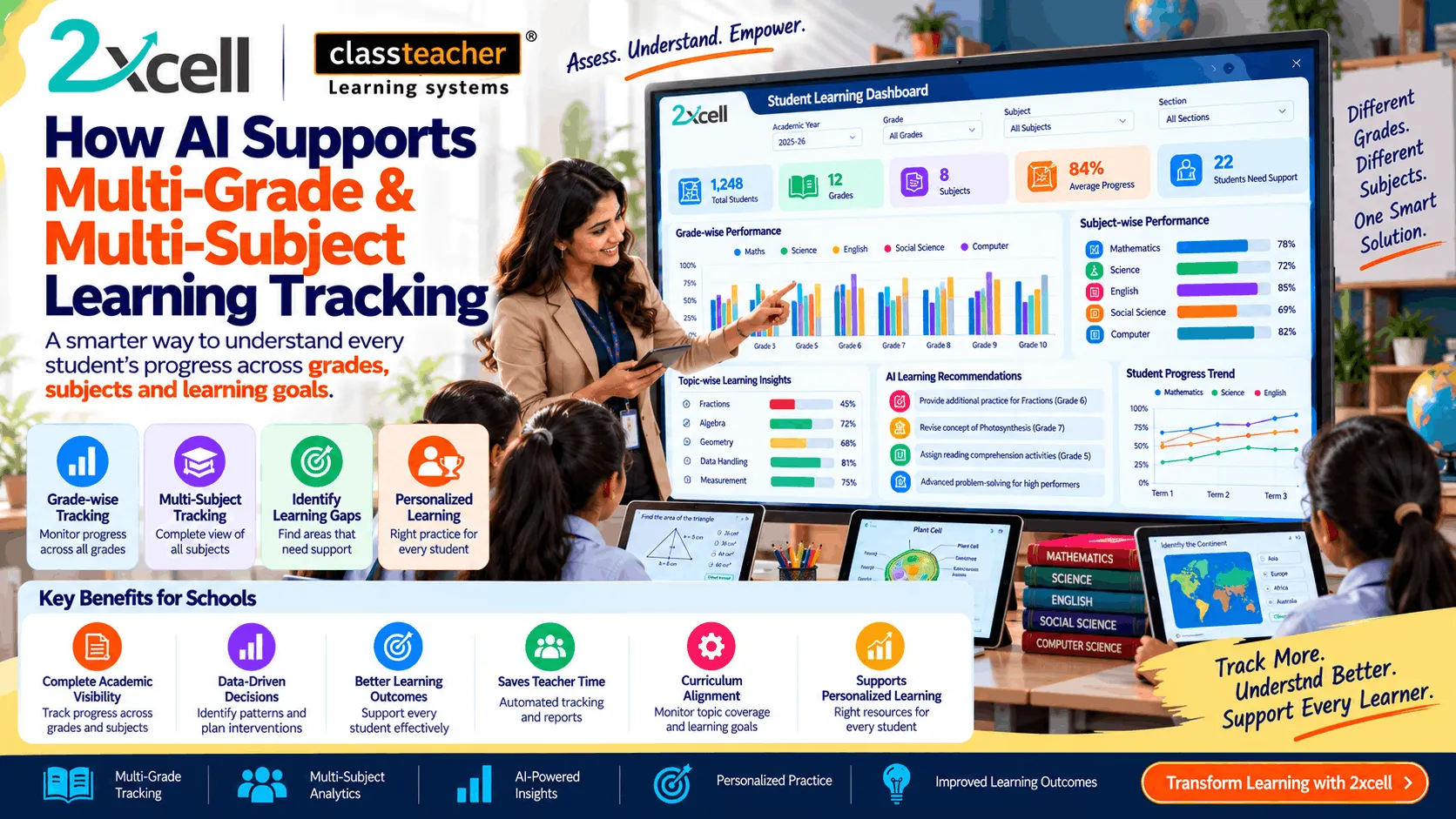
Artificial Intelligence (AI) can help schools organize and analyse learning information across multiple grades and subjects, making academic monitoring more structured and helping teachers identify where attention is needed.
A connected learning tracking process can follow:
Learn → Practise → Assess → Track → Analyse → Support → Improve
The goal is to make academic progress easier to understand and act upon, while keeping teachers at the centre of educational decisions.
What Is Multi-Grade and Multi-Subject Learning Tracking?
Multi-grade and multi-subject learning tracking refers to monitoring student performance and learning progress across different academic levels and subjects within a school.
For example, a school may need to monitor:
- Mathematics progress from Grades 3 to 10
- Science understanding across middle and secondary grades
- English reading and writing skills
- Computer Science and coding development
- Assessment results across different sections
- Learning gaps within individual subjects
- Progress towards grade-specific learning objectives
Each grade has its own curriculum requirements, while every subject has different ways of measuring understanding.
An AI-supported learning environment can help organize this information into a more connected view of academic progress.
Why Schools Need Better Learning Tracking Systems
Traditional academic monitoring often relies on spreadsheets, examination records, worksheets, and periodic teacher reports.
Although these methods remain useful, they can become difficult to manage as the number of grades, subjects, students, and assessments increases.
1. Managing Different Grade-Level Requirements
Students in different grades work towards different learning outcomes.
For example, a mathematics teacher may track basic arithmetic in Grade 4, algebraic concepts in Grade 7, and advanced mathematical applications in Grade 10.
A single monitoring approach may not capture the differences between these learning objectives.
AI-supported systems can help organize progress according to grade, subject, topic, and expected competency.
This gives teachers a clearer framework for reviewing performance at the appropriate academic level.
2. Tracking Multiple Subjects Without Fragmented Records
A student may perform well in English but require additional support in mathematics. Another student may demonstrate strong science knowledge while struggling with written explanations.
When subject information is maintained separately, understanding a student's overall academic progress can require reviewing several reports.
A connected tracking system can bring relevant subject-level information together while preserving the differences between academic areas.
The result is a broader view of student progress rather than a collection of disconnected scores.
3. Identifying Learning Gaps Across Subjects
Learning difficulties can occur at different levels.
A student may struggle with a specific concept, while an entire class may find a topic challenging. Sometimes, similar difficulties may appear across several sections or grades.
AI-powered analytics can help highlight patterns in assessment and practice data.
Teachers can then investigate whether students need additional explanations, different learning resources, more practice, or another form of academic support.
1. AI Can Organize Academic Data by Grade and Subject
One of the first requirements of effective learning tracking is structured academic information.
AI-enabled platforms can help organize relevant learning records according to:
- Grade and section
- Subject and topic
- Learning objectives
- Assessment results
- Practice activities
- Student progress
- Areas requiring improvement
For example, a school administrator could review mathematics performance for Grade 6 separately from Grade 9 while also examining broader trends across the school.
This structure can make academic records easier to review and compare appropriately.
2. AI Can Help Teachers Monitor Topic-Wise Progress
An overall subject score does not always explain what a student understands.
Consider a Grade 7 mathematics student who receives 68% in an assessment.
A topic-wise report might show:
- Fractions: Strong understanding
- Algebra: Developing
- Geometry: Needs additional practice
- Data Handling: Consistent performance
This information provides more direction than the overall score alone.
Teachers can identify which topics require revision and which concepts students are ready to apply at a more advanced level.
Subject Score → Topic Analysis → Learning Gap → Targeted Support
3. AI Can Support Progress Tracking Across Different Grades
Schools need to monitor current performance while also understanding how learning develops over time.
Grade-wise tracking can help academic teams review whether students are progressing towards the learning objectives associated with their current level.
For example, a school may monitor:
Grade 5: Understanding foundational mathematical operations
Grade 6: Applying operations to more complex problems
Grade 7: Using mathematical concepts in algebra and practical situations
This does not mean directly comparing students from different grades as if they were following identical curricula.
Instead, the focus is on tracking progress against appropriate grade-level expectations and identifying areas where foundational understanding may need reinforcement.
4. AI Can Identify Patterns Across Multiple Subjects
Learning information can sometimes reveal connections between subjects.
For example, a student who struggles with word problems in mathematics may also have difficulty interpreting written instructions in science.
This does not automatically mean the student has the same underlying difficulty in both subjects. However, the pattern may help teachers investigate whether reading comprehension, vocabulary, or problem interpretation requires additional attention.
AI can help highlight such patterns when relevant data is available.
Teachers can then examine the context and decide what support is appropriate.
5. AI Can Help Teachers Prioritize Students Who Need Support
Teachers often manage large classes with different learning requirements.
Reviewing every assessment manually can make it difficult to identify all students who may need attention.
AI-supported analytics can help flag indicators such as:
- Repeated incorrect answers
- Declining performance across assessments
- Difficulty with the same concept over time
- Incomplete practice activities
- Limited improvement after additional practice
These indicators should be treated as signals for teacher review, not definitive judgments about a student's ability.
By identifying areas for attention, the system can help teachers prioritize follow-up more efficiently.
6. AI Can Support Subject-Specific Assessment Tracking
Different subjects require different forms of assessment.
Mathematics may involve calculations and problem-solving. Languages may involve reading comprehension, grammar, and writing. Science may assess conceptual understanding, application, and interpretation of experiments.
A useful learning tracking system should preserve these differences.
AI-enabled platforms can help organize assessment results around relevant subject objectives and question types.
This can help teachers understand not only how students performed, but also which skills or concepts may require further development.
7. AI Can Help Teachers Monitor Improvement Over Time
A single assessment provides information about performance at a particular moment.
Tracking multiple assessments can show whether understanding is improving, remaining stable, or requiring further attention.
For example:
Learning checkpoint
Mathematics performance
Initial assessment
52%
After guided practice
64%
Follow-up assessment
74%
This example illustrates how progress can be monitored over time. The scores alone do not prove that one particular intervention caused the improvement, but they can help teachers evaluate whether further support is needed.
A structured process can follow:
Assess → Review → Support → Reassess → Compare Progress
8. AI Can Help Schools Review Class and Section Performance
Learning tracking is useful at the individual student level, but schools also need to understand classroom-level patterns.
For example, if many students in one Grade 8 section struggle with the same science concept, the teacher may decide to revisit the topic.
If the same issue appears across several sections, the academic coordinator may review the learning resource, assessment design, or teaching approach.
AI-supported dashboards can help organize these patterns for review.
The objective is not to label a class as weak or strong. It is to identify where instructional support could make a difference.
9. AI Can Support Personalized Practice Across Subjects
Students may need different levels of practice even when they are studying the same subject.
One student may need foundational questions, another may benefit from standard application exercises, and a third may be ready for advanced challenges.
Depending on the platform's capabilities, AI can help recommend learning resources or practice activities based on relevant performance information.
For example:
Mathematics: Additional fraction practice
Science: A visual explanation of a difficult process
English: Reading comprehension exercises
Coding: Step-by-step debugging activities
This approach keeps academic objectives in focus while allowing learning support to respond to individual needs.
10. AI Can Help Track Curriculum Coverage
Academic monitoring also involves understanding whether planned topics and learning objectives are being addressed.
Across multiple grades and subjects, school leaders may need to review:
- Topics completed
- Topics still pending
- Learning objectives covered
- Assessments conducted
- Revision activities completed
- Areas requiring follow-up
A centralized digital system can help organize this information and make it easier to review curriculum progress.
Teachers should retain the flexibility to adapt their instruction to classroom needs while working within the school's academic framework.
11. AI Can Reduce the Complexity of Manual Reporting
Preparing reports for several grades and subjects can take considerable time, especially when information comes from multiple sources.
AI-enabled reporting tools may help summarize relevant information into structured views for different users.
For Teachers
- Student-level progress
- Topic-wise performance
- Assessment results
- Areas requiring revision
For Academic Coordinators
- Grade-level patterns
- Subject-wise performance
- Curriculum progress
- Intervention requirements
For School Leadership
- Broader academic trends
- Progress across sections
- Areas requiring resources or training
- School-wide learning indicators
Automated summaries still require appropriate review to ensure that the information is accurate and meaningful.
12. AI Can Help Connect Assessment With Academic Intervention
Tracking progress is useful only when the information supports an appropriate next step.
Suppose a group of students repeatedly struggles with a particular geometry concept.
The school can use the assessment results to initiate a structured response:
- Identify the concept causing difficulty.
- Review student responses and common mistakes.
- Provide a clearer explanation or visual resource.
- Assign targeted practice.
- Conduct a follow-up assessment.
- Review whether understanding has improved.
This creates a link between academic monitoring and classroom action.
Data → Teacher Review → Intervention → Follow-Up → Progress
13. AI Can Support Communication Between Teachers and Academic Leaders
Teachers understand individual students and classroom conditions. Academic coordinators need a broader view across subjects, sections, and grades.
A connected tracking system can help both groups work with relevant information.
For example, a teacher may identify a recurring difficulty in Grade 6 mathematics. The coordinator can review whether similar patterns appear across other sections and decide whether additional resources or teacher collaboration would be useful.
This can support more informed academic discussions without replacing professional judgment.
14. AI Can Help Schools Recognize Learning Strengths
Learning tracking should not focus exclusively on problems.
Students may demonstrate strengths in particular subjects, skills, or types of activities.
A tracking system can help teachers recognize patterns such as:
- Strong analytical reasoning
- Consistent reading comprehension
- Effective scientific application
- Progress in coding
- Improvement in written communication
- Strong performance in practical activities
Recognizing these strengths can help teachers provide appropriate challenges and encourage students to continue developing their abilities.
15. AI Can Support Better Planning for Revision
Revision requirements may differ across subjects and grades.
A Grade 5 student may need regular practice with foundational arithmetic, while a Grade 10 student may need to revisit concepts that connect several advanced topics.
By reviewing assessment and practice information, teachers can identify which areas may benefit from revision.
A planned revision cycle can follow:
Review Previous Learning → Identify Gaps → Practise → Assess → Reinforce
This can make revision more focused than simply asking every student to repeat the entire syllabus.
16. AI Can Help Schools Evaluate Teaching Resources
Learning tracking may also provide insights into the resources students use.
For example, if many students struggle after completing a particular activity, teachers can review whether the explanation, instructions, or practice level needs adjustment.
However, student performance alone cannot establish that a resource is ineffective. Prior knowledge, attendance, teaching context, and assessment design may also influence results.
The data should therefore guide investigation rather than determine conclusions automatically.
17. AI Can Support Multi-Subject Learning in a Hybrid Environment
Students may learn through classroom instruction, digital resources, homework, projects, and independent practice.
When appropriate information from these activities is connected, teachers can gain a more complete view of learning progress.
A connected process could look like:
Classroom Lesson → Digital Content → Practice Activity → Assessment → Progress Review
This can help schools link classroom teaching with digital learning instead of treating each activity as a separate experience.
The availability of this information depends on the tools and integrations used by the school.
18. AI Can Help Teachers Plan Their Next Instructional Steps
Learning tracking can become more valuable when teachers use it to decide what to do next.
Depending on the information available, a teacher may decide to:
- Re-explain a difficult concept
- Introduce a visual demonstration
- Assign additional practice
- Provide a more challenging activity
- Arrange small-group support
- Review foundational knowledge
AI can help organize the relevant indicators, but teachers should consider classroom observations and student circumstances before choosing an intervention.
19. What Schools Should Consider Before Adopting AI Learning Tracking
Before introducing an AI-supported tracking system, schools should evaluate whether it meets their academic and operational requirements.
Curriculum Alignment
Can the platform organize learning around the school's grades, subjects, and learning objectives?
Data Accuracy
Are assessment results and student records reliable and up to date?
Useful Analytics
Do reports help teachers understand meaningful patterns instead of displaying unnecessary statistics?
Teacher Control
Can teachers review insights and decide the appropriate academic response?
Personalization
Can the system support different practice requirements where suitable?
Ease of Use
Can teachers and school leaders access the information without complicated workflows?
Privacy and Security
Are student records protected through appropriate access controls and data-handling practices?
Scalability
Can the system support additional grades, subjects, sections, and students as the school grows?
20. How 2xcell Can Support Connected Learning Tracking
The 2xcell AI Learning Platform by CLASSTEACHER Learning Systems can support a connected digital learning environment involving learning content, practice, assessments, analytics, personalized learning, and student progress tracking.
Within an appropriate implementation, schools can explore how these elements connect across their academic activities.
A connected learning journey can follow:
Learn → Practise → Assess → Analyse → Support → Improve
Relevant learning information can help schools review student performance, identify areas that may require additional practice, and support more informed academic discussions.
For multi-grade and multi-subject environments, the objective is to make learning information more structured and useful while respecting the distinct requirements of each grade, subject, and student.
The exact tracking and reporting capabilities depend on the platform configuration and available integrations.
Building a Practical AI-Based Learning Tracking Framework
Schools can introduce a structured process rather than attempting to monitor every possible indicator at once.
Step 1: Define Learning Objectives
Identify what students should understand in each grade and subject.
Step 2: Select Relevant Indicators
Choose meaningful measures such as assessment results, topic mastery, and progress over time.
Step 3: Organize Academic Information
Structure the data by grade, subject, section, and student.
Step 4: Review Patterns
Use reports and AI-assisted insights to identify areas that may need attention.
Step 5: Plan Support
Teachers select appropriate explanations, resources, practice, or interventions.
Step 6: Measure Progress Again
Use follow-up activities and assessments to evaluate changes in understanding.
Step 7: Improve the Process
Review what is working and adjust the academic support strategy.
This creates a continuous improvement cycle:
Define → Track → Analyse → Support → Measure → Improve
The Future of Multi-Grade and Multi-Subject Learning
As digital learning platforms and AI-assisted analytics continue to develop, schools may increasingly connect academic information across different grades, subjects, and learning activities.
A future learning environment could bring together:
- Grade-level learning objectives
- Subject-specific assessments
- Student progress records
- Personalized practice
- Teacher observations
- Academic dashboards
- Targeted learning support
The aim is not to reduce education to numbers or automated predictions.
It is to help teachers and school leaders understand learning progress more clearly and make better-informed decisions about student support.
Conclusion
Monitoring academic progress across multiple grades and subjects requires more than collecting examination marks. Schools need to understand topic-level performance, identify learning gaps, review progress over time, and determine where additional support may be useful.
AI can help organize academic information, highlight relevant patterns, support personalized practice, and make reporting more structured. Its value depends on accurate data, suitable implementation, responsible use, and teacher involvement.
With the 2xcell AI Learning Platform by CLASSTEACHER Learning Systems, schools can explore a connected approach to digital learning, assessment, analytics, and student progress tracking.
The goal is to create a clearer picture of learning across the school while helping teachers focus on what matters most: supporting each student's academic development.
Track Every Subject. Understand Every Stage. Support Every Learner.