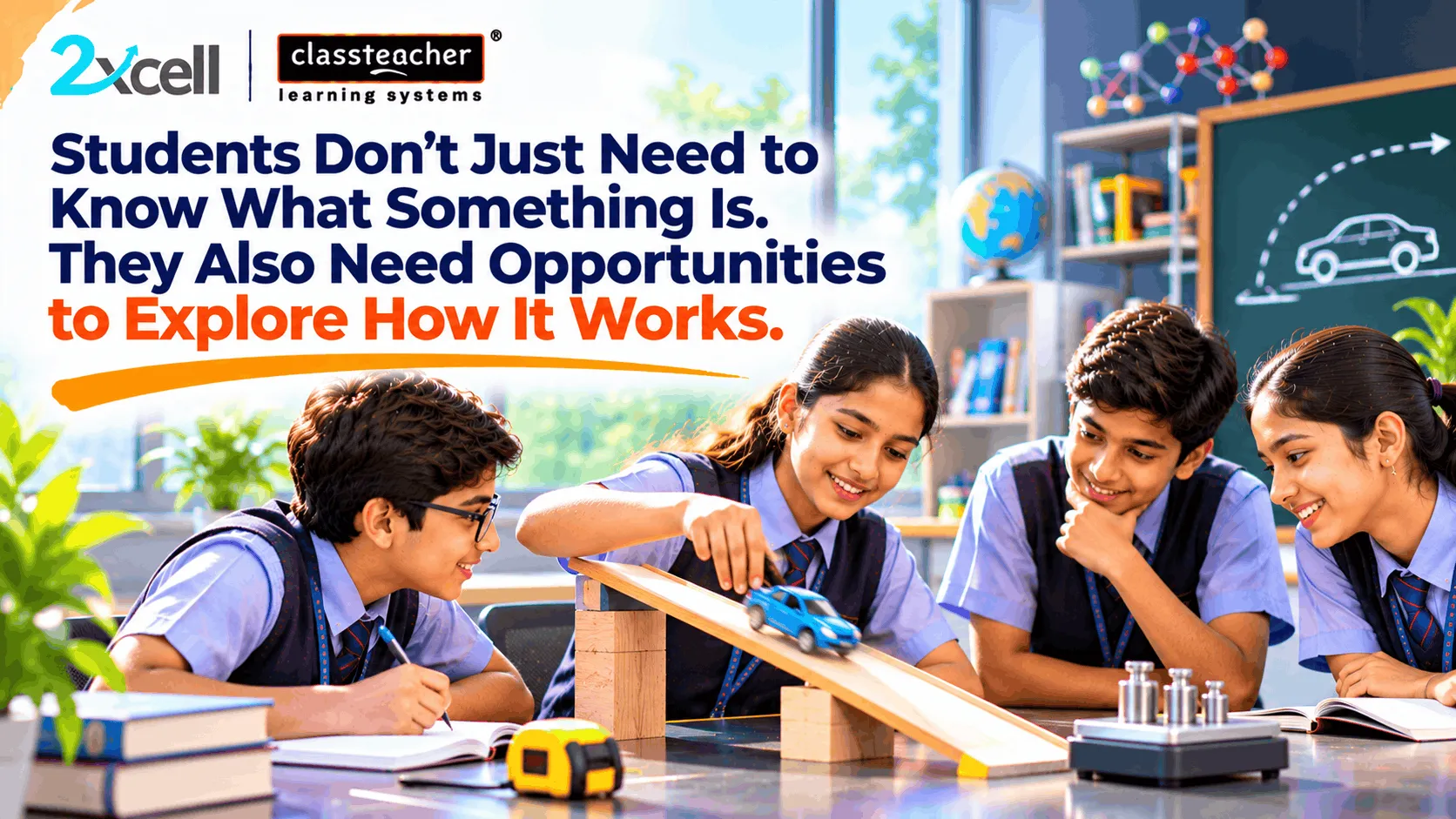
Introduction
Learning becomes more meaningful when students get the opportunity to investigate the ideas they study. Knowing a definition or remembering an explanation is important, but understanding how something works requires curiosity, observation, and practical exploration.
Imagine a student learning about the water cycle. Reading about evaporation and condensation introduces the concept, but observing water evaporate and form droplets on a cool surface can make the process easier to understand.
This difference between knowing and experiencing is an important part of effective education.
Schools can create more opportunities for students to explore concepts through carefully planned classroom activities. These experiences encourage learners to ask questions, test possibilities, discuss results, and develop their own understanding.
1. Move From Receiving Information to Exploring Ideas
In a conventional lesson, students often receive information through explanations, textbooks, and presentations. These methods provide an essential foundation, but students also need opportunities to interact with the information.
For example, while teaching the concept of balance, a teacher can explain the principle and then ask students to create a simple balancing structure using everyday materials.
Students can change the position of objects, observe the results, and identify what makes the structure stable.
This approach gives students an opportunity to investigate the concept rather than simply remember its definition.
Teachers can introduce exploration through:
- Simple classroom demonstrations.
- Guided experiments.
- Model-making activities.
- Observation-based assignments.
- Questions connected to everyday situations.
The purpose is to make students active participants in the learning process.
2. Start Every Activity With a Question
A useful practical activity often begins with a question that students want to answer.
Instead of explaining an entire concept immediately, teachers can introduce a situation that encourages learners to think.
For example:
- Can a paper structure support the weight of several books?
- Why does a shadow change its position during the day?
- Which shape makes a paper airplane fly farther?
- How does the amount of light affect plant growth?
- Can we design a simple system to separate different materials?
Students can first share their predictions and explain their reasoning.
After that, they can perform the activity and compare their expectations with the actual results.
This process encourages curiosity and helps students understand that learning involves investigation, not just receiving answers.
3. Give Students the Freedom to Test Their Ideas
Exploration becomes valuable when students have opportunities to try different approaches.
For instance, a teacher can ask students to build a small paper tower using a limited number of sheets. Rather than providing a fixed design, the teacher can allow each group to experiment with different shapes and structures.
Some designs may collapse, while others may remain stable.
Students can compare their results and discuss why one approach worked better than another.
Such activities help learners understand that there may be multiple ways to approach a problem.
They also encourage:
- Independent thinking.
- Creative decision-making.
- Logical reasoning.
- Practical problem-solving.
- Confidence in trying unfamiliar approaches.
Teachers should provide suitable guidance while allowing students enough space to make their own discoveries.
4. Observation Turns Everyday Experiences Into Learning Opportunities
Not every practical learning experience requires a laboratory or specialised equipment.
Everyday surroundings can provide useful opportunities to explore scientific and mathematical concepts.
For example, students can observe how water moves across different surfaces, compare the growth of plants in different conditions, or examine how the shape of an object affects the shadow it produces.
Teachers can ask students to record their observations and identify similarities or differences.
A simple observation activity can follow this structure:
- Select an object, process, or natural event.
- Ask students what they expect to observe.
- Give them time to examine it carefully.
- Record the results through notes or drawings.
- Discuss what the observations might mean.
This helps students develop attention to detail and understand the importance of evidence when explaining an idea.
5. Encourage Students to Discuss What They Discover
An activity should not end as soon as students complete the task. Discussion is an important part of helping them understand what happened and why.
After an experiment, teachers can invite students to explain their observations in their own words.
Different groups may notice different details or reach different conclusions. Comparing these perspectives can create valuable classroom conversations.
Useful discussion questions include:
- What was the most unexpected result?
- Did your observation match your prediction?
- What could have caused the difference?
- Would another approach produce a different result?
- What did you understand after completing the activity?
These conversations help students organise their thoughts and communicate their understanding more clearly.
6. Connect Practical Exploration With Real-World Problems
Classroom concepts become more relevant when students can recognise their applications outside school.
Teachers can introduce small challenges based on familiar situations.
Water Conservation: Ask students to identify where water is wasted and suggest practical ways to reduce it.
Waste Management: Give students an opportunity to classify different waste materials and explore suitable disposal methods.
Energy Awareness: Ask students to examine how electricity is used in their classroom and suggest ways to reduce unnecessary consumption.
Measurement: Let students calculate the materials needed to arrange a classroom activity area.
Design and Construction: Encourage students to create a model that addresses a simple everyday challenge.
These activities help learners understand that knowledge can be applied to situations beyond textbooks and examinations.
7. Mistakes Can Become Valuable Learning Experiences
Students may not always get the results they expect. A model might fail, an experiment may produce an unusual outcome, or a proposed solution may not work.
These situations should be treated as opportunities to investigate further.
For example, if a student-designed paper airplane does not travel as expected, the student can examine its shape, folds, and balance before trying a revised design.
Teachers can encourage students to think about what they would change and why.
This creates a learning environment where improvement is encouraged and mistakes are treated as useful information.
The process can help students develop patience, adaptability, and confidence when facing unfamiliar challenges.
8. Make Practical Learning Inclusive
Every student should have an opportunity to participate in classroom exploration.
Some students may enjoy building models, while others may prefer recording observations, drawing diagrams, explaining results, or organising materials.
Teachers can plan activities that allow different students to contribute according to their abilities and interests.
For group activities, responsibilities can be distributed so that every learner has a meaningful role.
An inclusive approach helps ensure that practical learning is not limited to students who are already confident with experiments or construction tasks.
It also creates opportunities for students to learn from one another.
9. How Teachers Can Measure What Students Have Learned
Completing an activity does not automatically mean that students have understood the concept.
Teachers should look at how students explain their work, interpret results, and apply their understanding in a different situation.
Some useful assessment methods include:
- Asking students to explain the process they followed.
- Reviewing their observation notes.
- Inviting them to demonstrate the concept.
- Asking them to compare different results.
- Giving them a related problem to solve independently.
- Encouraging short group presentations.
For example, after a lesson about floating and sinking, students could be asked to predict how an unfamiliar object might behave in water and explain the reasons behind their prediction.
This helps teachers assess understanding rather than simply checking whether students completed the activity.
10. Create More Opportunities Through Structured Learning Environments
Schools that want to introduce practical exploration more regularly can consider dedicated learning spaces and structured activity programmes.
Composite Skills Labs can provide opportunities for students to explore different areas of practical learning, depending on the equipment, curriculum, and activities available.
Students may work with models, scientific tools, technology resources, robotics components, and design-based projects.
The value of such environments comes from how students use the resources to investigate concepts and develop practical understanding.
Before establishing a skills lab, schools should consider:
- Curriculum and grade-level requirements.
- Available space and infrastructure.
- Suitability of equipment.
- Teacher training and guidance.
- Activity planning and implementation.
- Safety and maintenance requirements.
CLASSTEACHER Learning Systems works with schools exploring education-focused solutions and practical learning environments.
The 2xcell AI Learning Platform by CLASSTEACHER Learning Systems can also be evaluated separately according to its available capabilities and the school's digital learning objectives.
The choice of any solution should depend on the school's actual requirements and the learning outcomes it wants to support.
11. Small Activities Can Create a Culture of Curiosity
Practical exploration does not need to be limited to special events or occasional laboratory sessions.
Teachers can introduce short activities into regular lessons.
A five-minute prediction exercise, a simple classroom demonstration, a group observation task, or a small design challenge can provide students with an opportunity to investigate an idea.
Over time, these experiences can help create a classroom culture in which students feel comfortable asking questions and exploring possible answers.
Schools can support this culture by encouraging teachers to share activity ideas, exchange experiences, and review which approaches work best for their students.
Consistency and thoughtful planning are more important than making every activity complicated.
Conclusion
Students need opportunities to understand how concepts work, not just learn what they are called. Practical exploration gives them a chance to test ideas, observe results, ask questions, and connect classroom knowledge with everyday experiences.
Teachers can support this process through simple experiments, observation tasks, group discussions, design challenges, and real-world problem-solving activities.
For school leaders, the opportunity is to create an environment where exploration becomes a meaningful part of everyday teaching and learning.
At CLASSTEACHER Learning Systems, the focus is on exploring education solutions that support engaging and meaningful learning experiences.
When students are encouraged to investigate ideas themselves, they develop more than knowledge. They develop the curiosity and confidence to understand the world around them.