Introduction
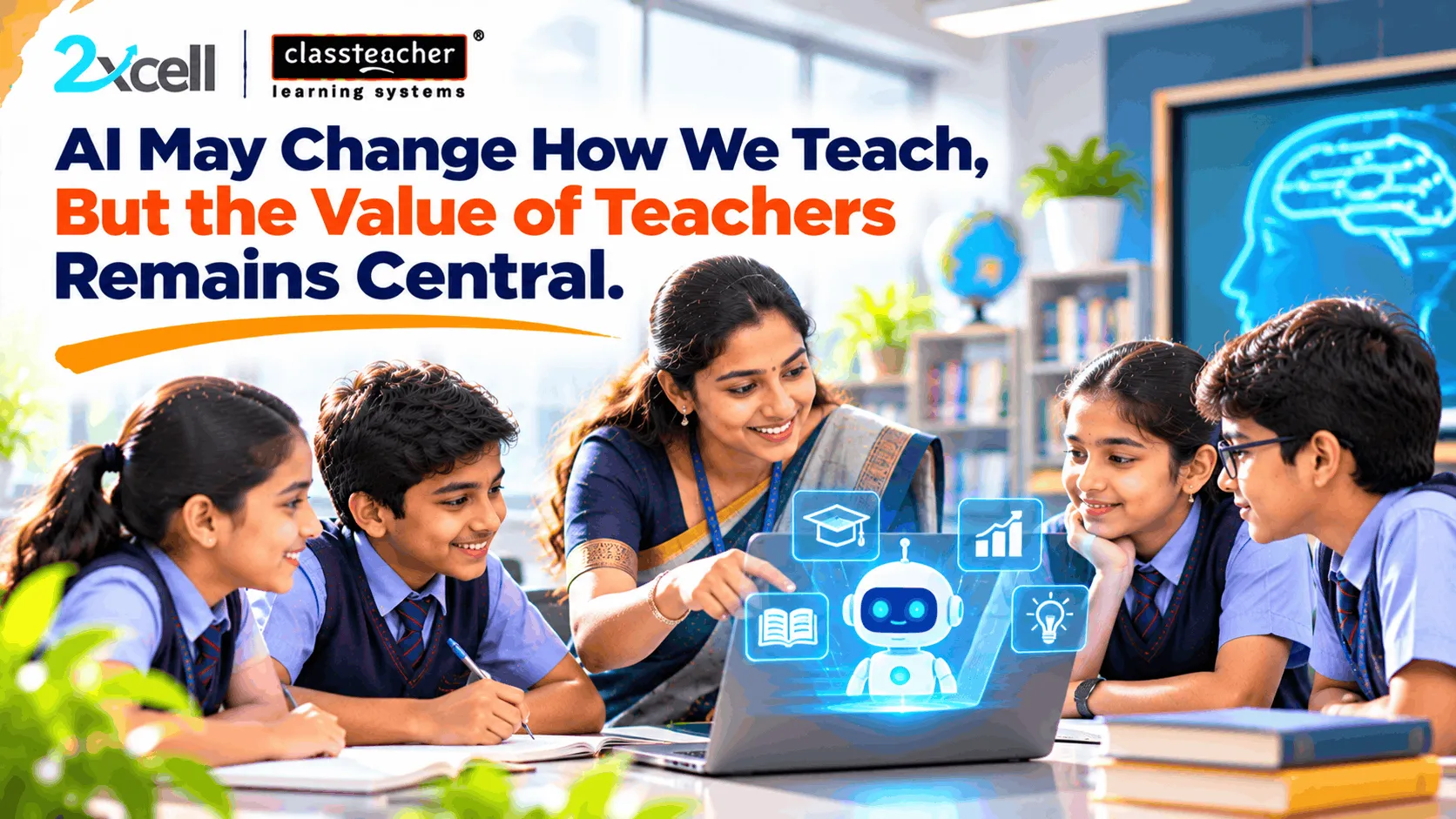
Artificial Intelligence is creating new possibilities for education. From personalised learning resources and automated assessments to AI-assisted lesson planning, technology is changing how schools approach teaching and learning.
However, as educational technology continues to develop, one thing remains essential: the role of teachers.
A teacher does much more than deliver information. Teachers understand individual student needs, encourage participation, manage classroom interactions, provide guidance, and help learners develop confidence.
AI can assist with selected educational tasks, but it cannot replace the importance of human understanding, professional judgment, and meaningful teacher-student relationships.
For schools, the real opportunity is to explore how AI can support educators without reducing the value of their contribution.
1. Teachers Bring Context That Technology Cannot Fully Understand
Every classroom includes students with different learning abilities, interests, confidence levels, and educational needs.
A student may understand a topic immediately, while another may need additional explanations or a different teaching approach.
Teachers observe these differences through classroom interactions, discussions, assignments, and everyday experiences.
For example, when a student repeatedly struggles with a mathematics problem, a teacher can identify whether the difficulty comes from understanding the concept, applying a formula, or lacking confidence.
An AI tool may help identify patterns in student performance, but teachers bring the classroom context needed to interpret those patterns appropriately.
Their understanding helps educators decide:
- Which students may need additional attention.
- When a concept requires another explanation.
- Which teaching approach may be more suitable.
- How classroom activities should be adjusted.
- When individual guidance may be necessary.
This human understanding remains important even as schools introduce more advanced technology.
2. AI Can Reduce Certain Tasks and Give Teachers More Time
Teachers often manage responsibilities beyond classroom instruction.
Lesson preparation, creating worksheets, organising learning resources, preparing assessment questions, and reviewing student performance can require considerable time.
Depending on the tools available, AI may assist with some of these activities.
For example, teachers can explore AI tools to:
Prepare Lesson Ideas: Generate initial activity suggestions based on a topic or learning objective.
Create Practice Questions: Develop draft questions at different difficulty levels for teacher review.
Organise Learning Resources: Summarise information or create structured outlines for classroom preparation.
Support Assessment Preparation: Generate draft rubrics or assessment formats that teachers can customise.
Adapt Explanations: Explore alternative ways to explain a difficult concept to different student groups.
These applications can support preparation and organisation, but teachers should review the output before using it.
The purpose is not to automate the entire teaching process. It is to identify suitable tasks where technology can reduce repetitive effort and support educators.
3. Human Interaction Builds Trust and Student Confidence
A positive classroom environment depends on more than educational content.
Students need an environment where they feel comfortable asking questions, sharing opinions, discussing mistakes, and seeking help.
Teachers play a central role in creating that environment.
A student who is hesitant to participate may need encouragement. Another student may need reassurance after making a mistake. Some learners may require individual conversations to understand their challenges.
These interactions involve empathy, observation, communication, and professional judgment.
AI tools can provide information or suggest learning activities, but the teacher remains responsible for understanding the student's situation and responding appropriately.
Technology should support these relationships rather than replace them.
4. Teachers Help Students Evaluate AI-Generated Information
AI systems can generate explanations, summaries, answers, and learning materials quickly. However, their outputs may sometimes contain incorrect information, incomplete explanations, or misleading conclusions.
Students therefore need guidance on how to evaluate what AI produces.
Teachers can help students develop responsible habits by encouraging them to:
- Verify information using reliable sources.
- Question answers instead of accepting everything automatically.
- Identify possible errors or missing context.
- Compare different explanations.
- Protect personal and sensitive information.
- Understand the importance of original thinking.
For example, a teacher could ask students to examine an AI-generated explanation of a science topic and identify whether the information is accurate.
Students can then compare the response with their textbooks and other trusted educational resources.
This approach helps develop critical thinking and digital responsibility.
5. Teacher Training Is Essential for Meaningful AI Adoption
Introducing AI tools into schools without preparing teachers can create confusion and inconsistent usage.
Educators need to understand not only how to operate these tools but also when and why they should use them.
A useful teacher training programme should include several areas.
Understanding AI Fundamentals
Teachers should learn what AI is, how common AI systems work, and what their limitations may be.
Practical Classroom Applications
Training should demonstrate how AI can support lesson preparation, resource creation, and selected learning activities.
Prompt Writing and Evaluation
Educators should learn how to provide clear instructions to AI tools and evaluate the quality of their responses.
Responsible and Ethical Use
Teachers should understand privacy considerations, information accuracy, bias, academic integrity, and appropriate student usage.
Classroom Integration
Training should help educators decide when AI is useful and when traditional teaching methods are more appropriate.
Continuous Learning
AI tools continue to evolve. Schools should consider refresher sessions and opportunities for teachers to share their experiences.
Effective training should be practical, relevant to teachers' responsibilities, and connected to the school's academic objectives.
6. AI Should Support Different Learning Needs
Students do not all learn in the same way or at the same pace.
Some may benefit from visual explanations, while others may understand a concept more effectively through examples, discussion, or repeated practice.
Depending on the available capabilities, AI-supported educational tools may help teachers explore different ways of presenting information.
For example, a teacher preparing a lesson on the solar system could explore:
- A simplified explanation for younger learners.
- A more detailed explanation for advanced students.
- Practice questions based on the topic.
- Examples that connect the subject with everyday experiences.
- Discussion questions for classroom participation.
Teachers can review and adapt these materials according to student requirements.
The teacher's role is to ensure that the content remains accurate, appropriate, and aligned with the intended learning outcomes.
7. Responsible AI Use Requires Clear School Guidelines
As AI becomes more accessible, schools need clear expectations about how students and teachers should use it.
Without suitable guidelines, students may depend excessively on AI-generated answers or share information without understanding privacy risks.
School management can establish practical policies covering:
Student Usage: Define which AI activities are permitted for different grade levels.
Teacher Responsibilities: Clarify how educators should review AI-generated educational content.
Data Privacy: Avoid entering confidential student information into tools that are not approved for such use.
Academic Integrity: Explain the difference between using AI for learning support and submitting AI-generated work as one's own.
Content Verification: Encourage users to check information before relying on it.
Transparency: Make appropriate disclosure expectations clear when AI is used in academic work.
These guidelines should be understandable, age-appropriate, and reviewed as technology develops.
8. The Changing Role of Teachers in an AI-Enabled Classroom
AI adoption may change some teaching activities, but it also creates opportunities for educators to focus on other important responsibilities.
Teachers can increasingly emphasise:
- Facilitating meaningful classroom discussions.
- Encouraging independent thinking.
- Supporting collaborative projects.
- Helping students interpret information.
- Guiding practical exploration.
- Developing communication and problem-solving skills.
- Providing individual academic support.
For example, instead of spending an entire lesson explaining information that students can explore through suitable learning resources, teachers may use classroom time for discussions, demonstrations, and application-based activities.
This does not make the teacher less important. It highlights the importance of planning, guidance, and meaningful interaction.
9. How School Leaders Can Prepare Teachers for AI Integration
Successful AI adoption requires more than purchasing software or introducing new digital tools.
School leaders should develop an implementation approach that considers teachers' readiness and the institution's educational priorities.
A practical approach can include:
Step 1: Understand Current Teacher Readiness
Identify teachers' familiarity with AI tools and their expectations or concerns.
Step 2: Identify Relevant Use Cases
Select applications that address actual teaching or administrative requirements.
Step 3: Organise Practical Training
Provide demonstrations and guided activities based on real classroom situations.
Step 4: Establish Responsible Usage Guidelines
Create clear policies around privacy, verification, student usage, and academic integrity.
Step 5: Begin With Limited Implementation
Introduce selected AI-supported activities before expanding usage across the school.
Step 6: Collect Teacher Feedback
Understand what educators find useful, what challenges they face, and where additional support is needed.
Step 7: Review and Improve
Evaluate adoption and make adjustments according to feedback and educational objectives.
This gradual approach allows schools to introduce AI thoughtfully rather than adopting tools without a clear implementation plan.
10. Exploring AI Learning Solutions for Schools
Schools interested in AI education should evaluate solutions according to their curriculum, teacher requirements, student age groups, and implementation goals.
AI learning programmes can provide opportunities for students to understand how intelligent systems work, explore their applications, and develop responsible digital skills.
Teacher preparation should remain an important part of these initiatives.
CLASSTEACHER Learning Systems works with schools exploring technology-enabled education and skill-development solutions.
The 2xcell AI Learning Platform by CLASSTEACHER Learning Systems can also be evaluated separately according to its available capabilities and the school's digital learning requirements.
When considering any educational technology solution, schools should examine its relevance, teacher training provisions, support arrangements, and expected learning outcomes.
The objective should be to introduce technology in a way that supports educators and creates meaningful opportunities for students.
11. Measuring Whether AI Is Actually Supporting Teachers
Schools should not measure successful AI adoption only by the number of teachers using AI tools.
They should also understand whether the technology is helping educators perform relevant tasks more effectively.
School leaders can collect feedback around:
- Time spent preparing selected learning resources.
- Teacher confidence in using AI tools.
- Relevance and quality of AI-generated materials.
- Frequency of classroom application.
- Teacher satisfaction and feedback.
- Student participation in AI-supported activities.
- Challenges related to accuracy, privacy, and usability.
Regular reviews can help schools identify which applications are useful and which require changes.
Importantly, evaluation should consider the quality of teaching and learning rather than treating AI usage as an achievement by itself.
Conclusion
Artificial Intelligence may introduce new ways to prepare lessons, organise educational resources, and support selected classroom activities. However, the value of teachers remains central to meaningful education.
Teachers understand student needs, build trust, encourage curiosity, guide discussions, and help learners make sense of information.
AI can assist with certain tasks, but responsible implementation requires human judgment, appropriate training, and clear educational objectives.
For school leaders, the priority should be to prepare teachers for the changing educational environment rather than simply introducing more technology.
At CLASSTEACHER Learning Systems, we believe educational innovation should support teachers and create better learning opportunities for students.
The future of education is not about choosing between teachers and technology. It is about bringing them together in a thoughtful way that keeps learning, guidance, and human understanding at the centre.