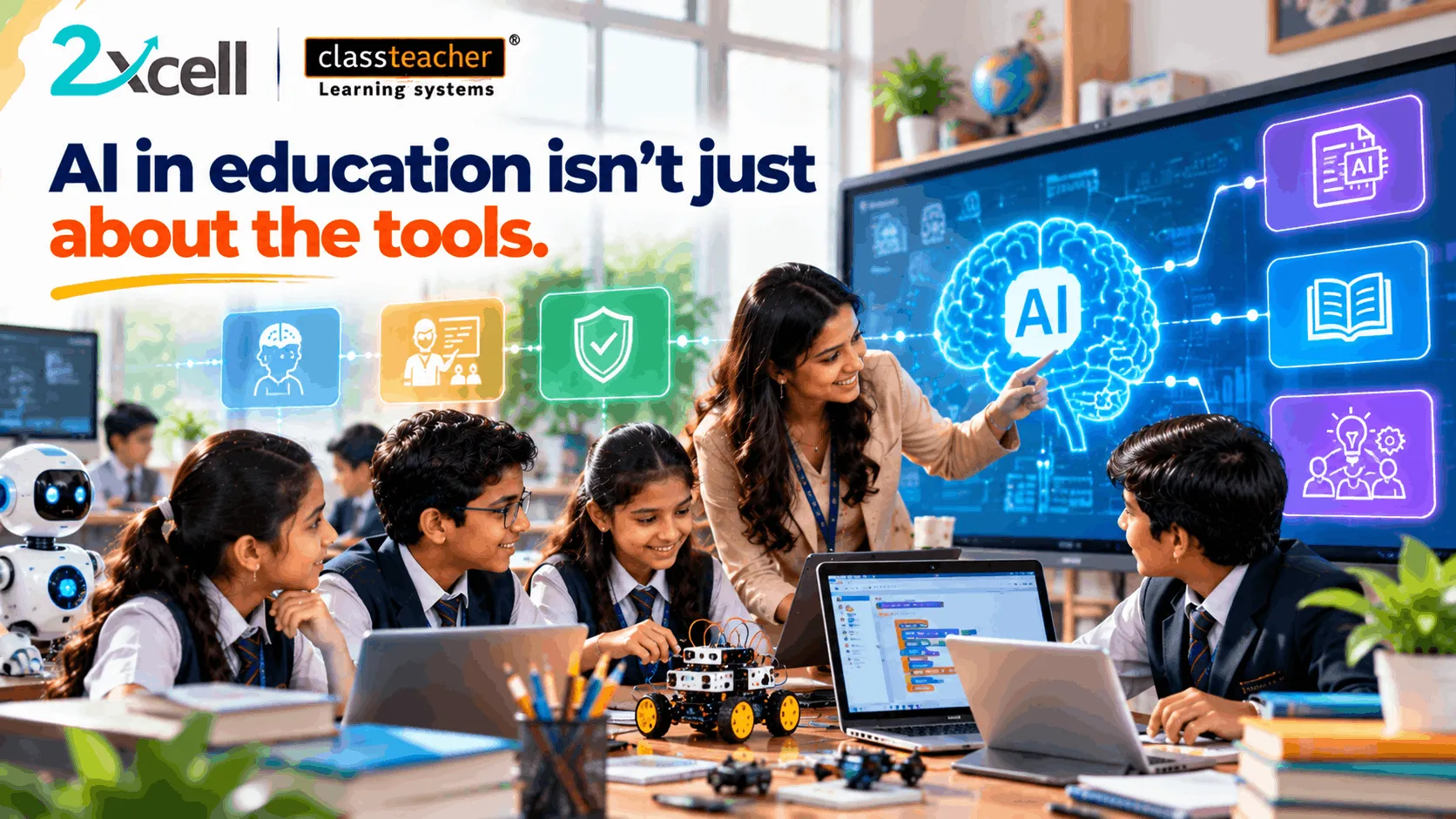
Artificial Intelligence is creating new possibilities for schools, teachers, and students. From digital learning resources to AI-assisted activities, educational technology can offer new ways to explore concepts, practise skills, and understand academic progress.
However, introducing AI into a classroom does not automatically improve education. The real value depends on how the technology is used, whether teachers are prepared to guide students, and whether the activities support meaningful learning objectives.
Schools need to look beyond the tools themselves and consider a more important question:
How can AI help create better learning experiences for every student?
The answer begins with purposeful implementation. Age-appropriate activities, teacher guidance, responsible use, practical experimentation, and clear learning goals can help schools make AI education more meaningful.
The objective is not to replace effective teaching with technology. It is to explore how technology can support teachers and give students additional opportunities to understand, question, create, and solve problems.
What Does AI in Education Really Mean?
AI in education refers to the use of artificial intelligence to support selected teaching, learning, and academic activities.
Depending on the application, AI-related educational tools may help teachers prepare learning materials, provide practice activities, organize information, or explore different ways of explaining a concept.
For students, AI education can also involve understanding how intelligent systems work, examining their limitations, and learning to use them responsibly.
Schools may explore AI through activities such as:
- Understanding basic AI concepts.
- Exploring patterns and data.
- Practising coding and computational thinking.
- Using digital tools to investigate questions.
- Evaluating AI-generated information.
- Developing solutions to practical problems.
- Discussing ethical and responsible technology use.
The most important consideration is the educational purpose behind each activity.
A tool should not be introduced simply because it is new or popular. Schools should first identify what students need to learn and then determine whether AI can support that objective.
1. Age-Appropriate Learning Activities Should Come First
Students at different stages of their education have different levels of understanding, experience, and digital readiness.
An AI activity suitable for a senior secondary student may be too complicated for a primary school learner. Schools should therefore introduce AI concepts gradually and in ways that match students' developmental needs.
For younger learners, activities might focus on recognizing patterns, following logical instructions, or understanding how computers respond to information.
Older students may explore coding, data analysis, machine learning concepts, or the limitations of AI-generated responses.
Age-appropriate AI learning can include:
- Simple pattern-recognition exercises.
- Guided coding activities.
- Interactive demonstrations.
- Classroom problem-solving challenges.
- Discussions about online safety.
- Supervised exploration of AI tools.
For example, a younger student could learn how a system identifies patterns in pictures, while an older student could investigate how training data influences an AI model's output.
Both activities introduce AI, but at different levels of complexity.
The key principle: AI education should match the learner's age, understanding, curriculum, and support requirements.
2. Teachers Need Guidance and Training
Teachers remain central to effective education. They understand classroom dynamics, student needs, curriculum expectations, and the context in which learning takes place.
When AI tools are introduced without adequate guidance, teachers may find it difficult to determine which applications are appropriate, how to evaluate generated content, or how to integrate technology into existing lessons.
Teacher preparation should therefore be an essential part of any AI education initiative.
Schools can support teachers through:
- Practical AI literacy workshops.
- Training on educational applications.
- Guidance for evaluating generated content.
- Examples of curriculum-aligned activities.
- Classroom implementation guidelines.
- Opportunities to share experiences with colleagues.
For instance, a teacher might use an AI tool to draft questions for a lesson. Before using those questions, the teacher should check their accuracy, difficulty, language, and alignment with the intended learning outcomes.
Professional judgement remains necessary at every stage.
Teacher training should focus not only on operating tools but also on deciding when to use them, when to avoid them, and how to guide students effectively.
3. Responsible and Ethical AI Use Must Be Taught
Students need to understand that AI-generated information is not automatically correct, complete, or unbiased.
An AI system may produce inaccurate explanations, misunderstand a question, or present unsupported information confidently. Students who rely on its answers without checking them may develop misconceptions.
Responsible AI education should help learners understand both the possibilities and the limitations of the technology.
Schools can introduce important principles such as:
- Verifying information through reliable sources.
- Protecting personal and sensitive information.
- Respecting academic integrity.
- Recognizing potential bias.
- Understanding the limitations of automated systems.
- Using AI in accordance with school policies.
- Giving appropriate credit for work and ideas.
For example, students could compare an AI-generated explanation of a scientific topic with their textbook and other trusted educational resources. They can identify differences, verify claims, and explain which information is supported by evidence.
This activity develops more than AI familiarity. It encourages independent judgement and responsible decision-making.
Schools should also establish clear policies on student data, age restrictions, parental involvement where appropriate, and acceptable uses of AI tools.
Responsible AI literacy means knowing not only how to use a tool, but also how to question its output and understand its limitations.
4. Students Need Opportunities to Experiment and Solve Problems
AI education becomes more meaningful when students move beyond listening to explanations and begin exploring how ideas work.
Practical activities encourage students to ask questions, test possibilities, examine outcomes, and improve their approaches.
Schools can introduce experimentation through:
- Coding and robotics projects.
- Guided AI demonstrations.
- Data and pattern-recognition activities.
- Interactive simulations.
- Real-world problem-solving challenges.
- Team-based innovation projects.
Imagine a classroom activity in which students investigate how a school could reduce electricity consumption. They might collect information, identify patterns, compare possible solutions, and present their recommendations.
AI-related tools could support selected stages of the activity, but students would still need to evaluate the evidence and justify their conclusions.
This type of learning encourages curiosity, creativity, logical reasoning, and practical application.
The learning process becomes:
Question → Explore → Experiment → Analyse → Improve
The purpose is not simply to teach students how to operate AI tools. It is to help them develop the confidence and reasoning skills needed to investigate unfamiliar problems.
5. Every AI Activity Needs a Clear Learning Objective
Technology can attract attention, but engagement alone does not guarantee learning.
Before introducing an AI-powered activity, schools should identify what students are expected to understand or achieve.
For example, an activity involving an AI-generated story might have different educational objectives:
- Understanding how AI generates text.
- Identifying factual errors in generated content.
- Improving writing and editing skills.
- Examining bias in language.
- Comparing human and AI-generated explanations.
Each objective requires a different activity and assessment approach.
Teachers should consider three questions before selecting a tool:
- What should students learn from this activity?
- How will the activity support that learning objective?
- How will we determine whether students understood the concept?
These questions help prevent technology from becoming a distraction from the curriculum.
A well-designed AI activity should have a clear academic purpose, appropriate teacher guidance, and a meaningful way to evaluate learning.
6. AI Should Support Teachers, Not Replace Teaching
Effective teaching involves much more than delivering information. Teachers explain difficult concepts, encourage participation, recognize emotional and academic needs, and adapt lessons according to classroom circumstances.
AI can support selected tasks, but it cannot be assumed to understand every student's situation or provide the right response in every context.
A teacher may use AI to prepare practice questions, explore alternative explanations, or organize lesson materials. The teacher must still decide whether the content is appropriate and how it should be used.
A balanced approach follows:
AI Provides Support → Teacher Reviews → Students Engage → Learning Is Evaluated
Schools should encourage teachers to use AI where it offers genuine value while preserving their authority over instructional decisions.
The aim is to improve the learning experience, not to automate every part of education.
7. Schools Should Connect AI Learning with Existing Subjects
AI literacy does not have to exist as an isolated activity. Schools can introduce relevant concepts through mathematics, science, computer science, languages, and other subjects.

Mathematics
Students can explore patterns, organize data, compare results, and examine how different inputs affect an outcome.

Science
Students can investigate predictions, analyse observations, and compare AI-generated explanations with experimental evidence.

Computer Science
Students can explore coding, algorithms, data, and the basic principles behind intelligent systems.

Languages and Humanities
Students can evaluate written information, improve drafts, compare perspectives, and discuss the reliability of generated content.
Connecting AI with existing subjects can help students understand its practical relevance while maintaining curriculum priorities.
8. How Schools Can Begin Implementing AI Education
Schools do not need to introduce every available technology at once. A gradual approach allows educators to understand what works, address challenges, and improve implementation.
Step 1: Identify learning priorities. Determine whether the school wants to strengthen AI literacy, coding, problem-solving, digital research, or teacher preparation.
Step 2: Review suitable resources. Evaluate age appropriateness, educational value, accessibility, privacy, and curriculum alignment.
Step 3: Prepare teachers. Provide guidance on tool selection, responsible use, classroom activities, and content verification.
Step 4: Start with a pilot activity. Introduce a small number of activities in selected grades or subjects.
Step 5: Review student learning. Examine student understanding, participation, work quality, and teacher feedback.
Step 6: Refine and expand. Improve the activities before introducing them more widely.
This approach makes AI adoption a planned educational process rather than a collection of disconnected technology experiments.
9. How 2xcell Can Support a Connected Digital Learning Environment
2xcell AI Learning Platform by CLASSTEACHER Learning Systems can form part of a school's broader digital learning strategy.
Depending on the features available and implemented, a connected learning environment can support digital content, practice, assessments, analytics, personalized learning, and student progress tracking.
A structured learning journey can follow:
Learn → Practise → Assess → Analyse → Improve
These elements can complement AI literacy activities by helping schools connect learning resources with practice and academic progress.
For example, a teacher can introduce a concept, provide relevant practice, review student performance, and determine whether additional explanation is needed.
Schools evaluating 2xcell or any other educational platform should review its actual capabilities, curriculum suitability, teacher usability, data protection measures, and educational value.
Technology should support a clear learning strategy, with teachers continuing to guide students and evaluate their understanding.
10. Measuring Whether AI Is Improving Learning
Schools should evaluate AI education by examining its contribution to learning rather than simply counting the number of tools introduced.
Useful indicators may include:
- Students' understanding of basic AI concepts.
- Ability to verify information.
- Quality of problem-solving.
- Responsible use of digital tools.
- Student participation in practical activities.
- Teacher confidence and preparedness.
- Progress towards defined learning objectives.
For example, students could complete a project that requires them to use AI-generated information, verify its accuracy, and explain their conclusions.
Teachers can assess whether students understood the subject matter, evaluated the information carefully, and used the technology responsibly.
Regular evaluation helps schools determine which activities are useful and which need improvement.
Conclusion
AI in education is not simply about introducing new tools into classrooms. It is about creating learning experiences that help students understand concepts, investigate questions, solve problems, and use technology responsibly.
Age-appropriate activities, teacher training, ethical guidance, practical experimentation, and clear learning objectives provide a strong foundation for meaningful AI education.
Schools should adopt technology thoughtfully, evaluate its educational value, and ensure that teachers remain central to the learning process.
With 2xcell AI Learning Platform by CLASSTEACHER Learning Systems, schools can explore a connected approach to digital learning, practice, assessment, analytics, and student progress tracking as part of their wider educational strategy.
The future of AI education will depend not only on the tools schools introduce, but also on how effectively they use them to support students and teachers.
Teach with Purpose. Explore AI Responsibly. Build Better Learning Experiences.